Expertise provided by Dr. Doyle, Geoffrey A Doyle
You said yes to the plans last week. Then your back or neck flared up, you were too tense to be good company, and you texted that you had to cancel. Maybe it has happened more than once, so the invitations come a little less often, and you keep telling yourself you will catch up when you feel better. This guide is for that exact moment, when part of you wants to hang out with a friend today and the rest of you wants to stay flat on the couch with a heating pad.
Dr. Geoff Doyle, owner and lead doctor at Doyle Chiropractic in Huntersville, NC, sees the other side of that story in his office. One patient told him about playing on the floor with their kids again, another mentioned getting up and down the stairs at home with less difficulty, and another said things at home felt easier with less soreness. Experiences like these are individual, and they do not happen in one visit. They do point to something simple: when you feel better, you may treat people better, and when you spend time with people, you may feel a little better too. A hangout is not a cure. It is a small first step, and the seven ideas below are built for a body that hurts.
1. Why Should You Hang Out With a Friend Today, Even When You Hurt?
You might choose to hang out with a friend today because pain and stress can feed each other, and pulling away from people may make both feel heavier. A short, easy visit with someone you trust costs nothing, and it may help interrupt that loop for some people.
Dr. Doyle puts it plainly: stress and anxiety are not physical objects. You cannot go buy a bucket of anxiety. They live in your brain and your emotions, and they can contribute to physical problems in the body whether you realize it or not. You might notice it as shoulders that creep up near your ears by the end of the day, or a neck that feels tight before you have even looked at a screen.
At Doyle Chiropractic, many patients arrive with more than one kind of concern: physical, mental, emotional, and spiritual. The team talks about all of it openly and honestly, because some of it can be tied together. It can also work the other way, and that is where some people find themselves in what feels like a spiral. Pain keeps you home, staying home can add stress and isolation, and the stress can make pain feel louder. Canceling plans is often one of the first signs of that spiral.
Friendship may push in the opposite direction. One major medical center’s health library notes that good friends can boost happiness, reduce stress, and give you a stronger sense of belonging and purpose. That is why Doyle Chiropractic treats you as a whole person and not a set of separate parts, and why time with a friend can be a real part of the picture rather than a nice extra.
2. Choose a Walk Over a Long Sit
So what kind of hangout may work well when you hurt? If your discomfort comes from a desk, a laptop, or your phone, a slow walk with a friend may suit you better than three hours on a couch or at a restaurant table. Gentle movement keeps joints and muscles working, while a long sit can pile more load onto the same tired tissues you sit on all week.
Tech neck and desk-driven posture problems are among the most common modern concerns the team at Doyle Chiropractic sees. Your head drifts forward and your shoulders round, so the muscles along your neck and upper back can end up restricted and guarded from holding that position hour after hour. A movie marathon or a long lunch can put you right back in that shape. A walk lets your arms swing, your head come up, and your spine move the way it is built to move.
Here in Huntersville, that can be as simple as grabbing a coffee in town and walking while you drink it instead of sitting down. You could also do an easy loop around your neighborhood after dinner when the air cools off. Start with a short distance you know you can finish. Walking side by side has a bonus, too: you look out at the street instead of down at a phone, so your neck gets a break while you talk.
A walk may help, but it is not the whole picture. Many people hope a new pair of shoes, a new mattress, or a new pillow will address discomfort they have had for years. Support tools only support whatever condition you give them. Doyle Chiropractic asks which tissues are involved and what may be contributing to the symptom, and then works on the tissue and the underlying condition. Ask what you can do on your own between visits, too, so you leave with a game plan and not just a hope.
3. What Gentle Stress Tools Can You Share With a Friend?
Once you are moving, you can add something calming. Meditation, tai chi, and qi gong are three low-cost, low-time stress tools you can try side by side with a friend. Doyle Chiropractic gives patients at-home guidance on all three because they do not take a lot of time or a lot of money.
Each one is easy to start. Meditation can be a few quiet minutes of slow breathing, sitting in chairs that support your back, with your phones face down. Tai chi uses slow, flowing movements and gentle shifts of weight. Qi gong pairs easy movement with steady breathing. None of them asks you to twist hard, lift heavy, or push through pain, which can make them a good fit on days your body is not up for much. Doing them with a friend in a living room or backyard in Huntersville adds something a solo app cannot: someone who notices when you skip it and shows up again next week.
The social side may be part of the benefit. NIH News in Health reports that researchers keep finding links between social ties and health, and that the quality of those relationships matters, not only how many people you know. A calm half hour with one good friend may feel better than a crowded event that leaves you drained and sore.
Dr. Doyle is a second generation chiropractor and acupuncturist, so the office has more natural options for stress than many people expect from a chiropractor. Acupuncture is often used with the goal of easing pain and other symptoms, and the red light bed is used for whole-body inflammation and sometimes for people having trouble sleeping. Medication is often used for anxiety, and if you take it, keep working with the doctor who prescribed it. These options may be worth discussing alongside that care. You can choose one or two, or a combination, because the choice is always up to you.
4. Why Should You Tell Your Friend the Truth About Your Pain?
Picking the right activity works best if your friend knows what you are dealing with. Tell them the truth, because nobody can help with pain you keep hiding, and that goes for your doctor too. Saying “my back is bad today, can we walk instead of sitting?” can turn a plan you would cancel into one you may be able to keep.
Dr. Doyle sees people downplay their pain. Sometimes it is ego, and sometimes it is wanting to be a little tougher, for themselves or for someone else. Often people just do not want to make the situation seem too bad. So they check a lower number on the paperwork and say they are only a little stiff. By the time he has all the information, the condition can turn out to be more involved and years in the making.
The same thing happens in friendships. You say “I’m fine,” then bail an hour before you were supposed to meet, and your friend wonders if you are avoiding them. If you are honest instead, they can work with you. They can pick a spot with real chairs instead of a low, soft couch, park close to the door, or swap a long dinner for a short walk. Honesty is not complaining. It gives the people who care about you something useful to do.
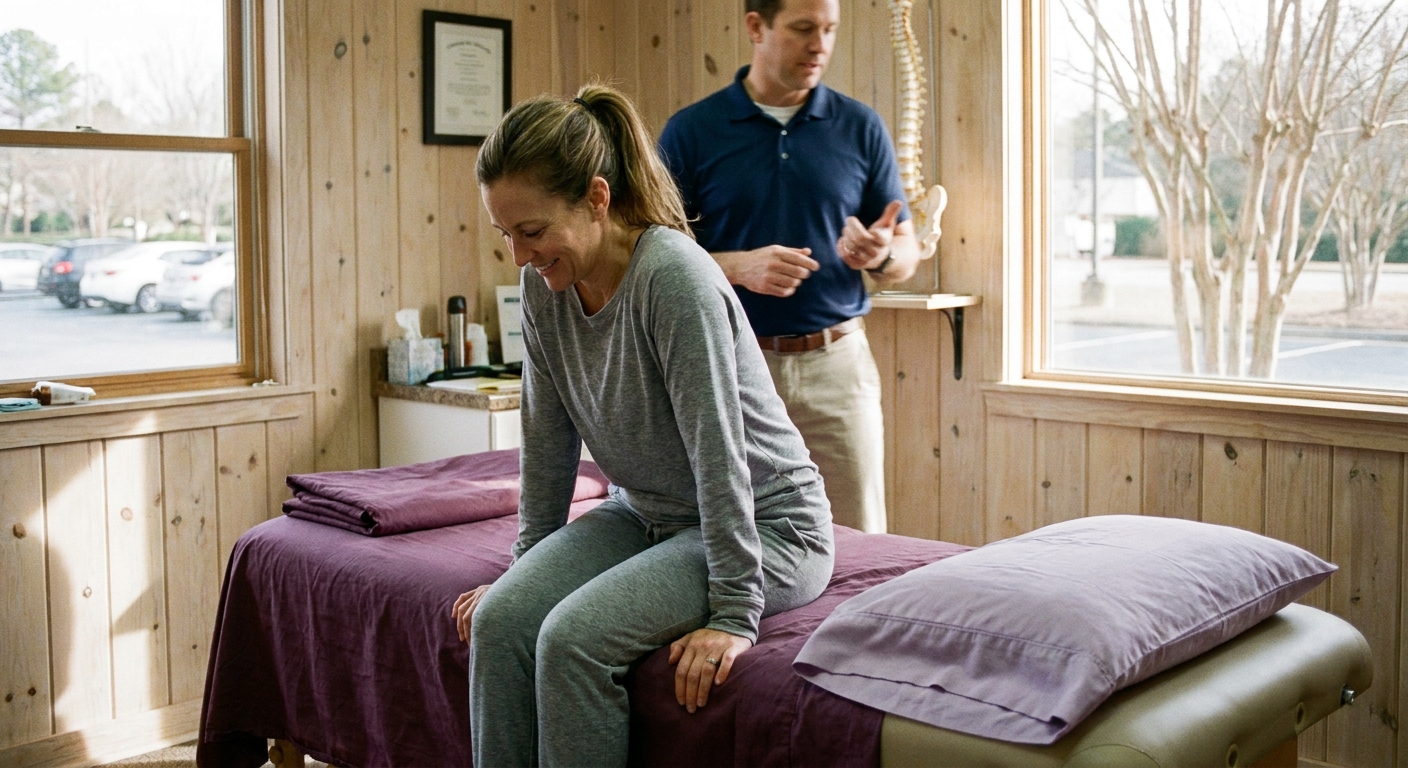
In the exam room, Dr. Doyle does not rely only on what you say. Having grown up in a chiropractic family, he has spent his career learning to read a body with his hands. He feels for tight and tender fibers and heat coming off irritated areas. He watches for guarding or wincing when he touches a spot, checks how a joint feels and moves, and notes whether your symptoms reproduce. Those findings help guide your care alongside how you feel that day. Your symptoms still get addressed, and the broader goal is supporting the tissues so they can work better, since tissues that work better may hurt less. Telling him the truth simply makes that picture clearer, sooner.
5. Can a Friend Come With You to Your First Chiropractic Visit?
Often, yes, and having someone you trust in the waiting room may take the edge off a nervous first visit. Call Doyle Chiropractic before your appointment to check, so the office can plan for it.
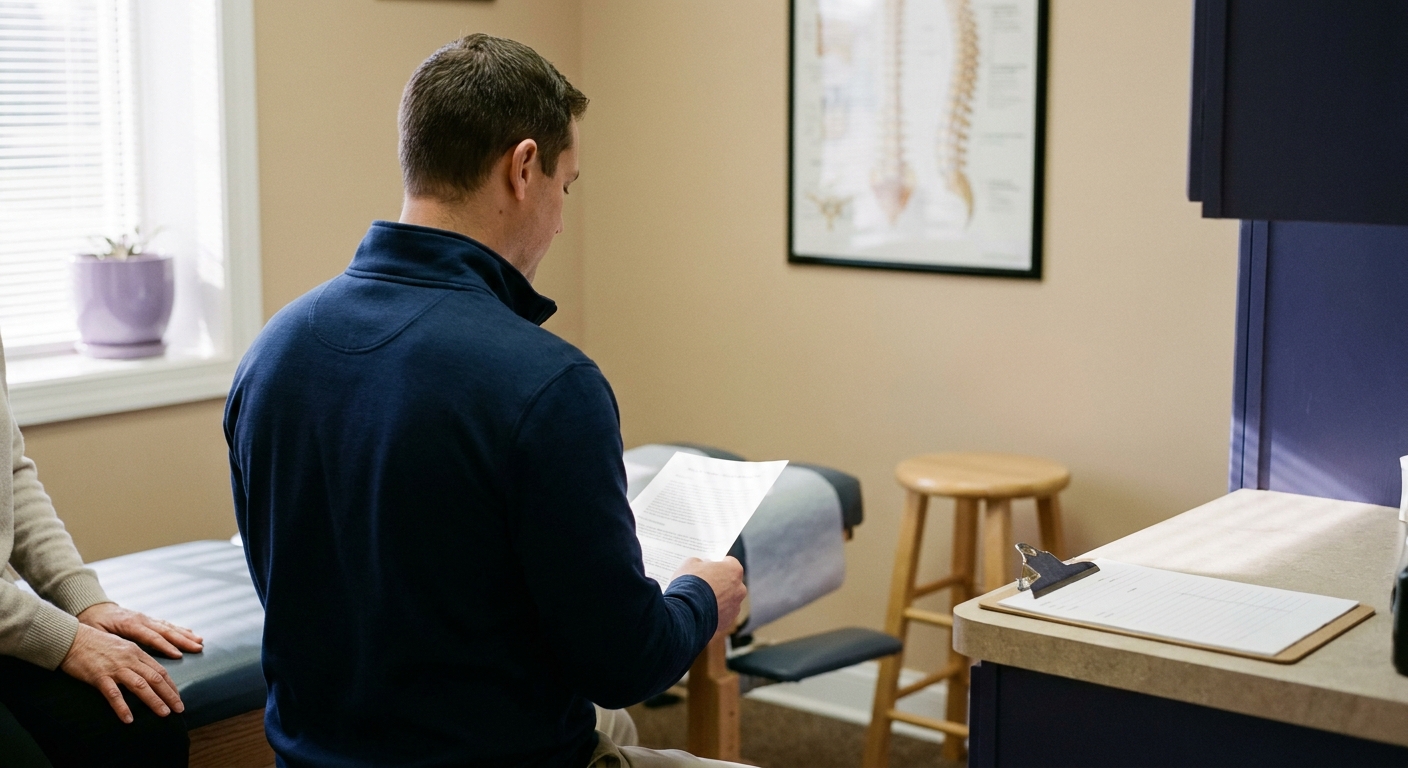
Many people walk in picturing the rough, loud adjustments they have seen in social media videos, and that alone keeps some of them from ever booking. Doyle Chiropractic welcomes nervous first-timers. Dr. Doyle compares it to going into surgery: you can trust the doctor and still be scared, because the unknown is scary. So the first visit is built to reduce the unknown. The front desk greets you standing up and by name. When Dr. Doyle comes into the room, he knocks, introduces himself, and starts by asking you to tell him what bothers you most. Nobody pushes or pokes on anything while you are still talking.
If X-rays are needed, they are digital, so he can review them with you right then. The exam only starts with your permission. He tells you where his hands are going, starts very gently, and adds pressure only if you are handling it well. If something feels uncomfortable, he stops right away, so you are in control the whole time. If you are nervous about being adjusted, he can walk you through a seated adjustment, a specific gentle prone adjustment, or an activator adjustment, the three gentlest options in the office. The pressure can be as light as what it takes to turn your fingertip white. As Dr. Doyle says, less is more, and sometimes all he needs to do is get a joint moving or a muscle slightly relaxed, and the body may take it from there. One patient was surprised by how simple and comfortable the first visit felt.
A friend can help you remember your questions and jot down the options. Dr. Doyle usually lays out a couple, and up to four, treatment choices, and you can decide on the spot or go home and think about it. If you tried chiropractic before and it did not last, say so. Dr. Doyle admits he could talk till he is blue in the face, but trust tends to build as you see how your own care unfolds.
6. Match the Hangout to Your Body’s Limits
Whether it is a doctor’s visit or a coffee date, pacing matters. Plan the outing around your worst likely moment, not your best one. Keep it short, know where you can sit, and have an easy backup. That way you may be less likely to cancel, and less likely to pay for it for the next two days.
A few habits can make a difference:
- Agree on a short window, like an hour, with the option to stay longer if you feel good.
- Choose places with chairs that have backs, and skip the deep, sunken couch.
- Drive yourself, so you can leave without making it a big deal.
- Tell your friend up front that you may need to stand and move every so often.
- Keep an indoor backup ready, like a slow lap around a store or a cup of coffee at your kitchen table, in case the weather turns or your back does.
Short visits can still count. A health newsletter from a leading medical school points to research suggesting that people who mix different kinds of social contact into their days tend to report better well-being. A twenty-minute walk, a quick phone call, and a short chat with a neighbor can all add up, so you do not need a big outing to get something out of it.
The same pacing idea runs through care at Doyle Chiropractic. Care usually starts with gentler techniques, and Dr. Doyle tests each joint before moving to the next level, with the aim of progressing steadily. Under one roof, the office offers chiropractic, acupuncture, the red light bed, Class 4 laser, cupping, and decompression, and care plans often combine them based on which tissues are involved. The laser is used with the aim of supporting tissue repair, acupuncture for pain and symptom management, cupping for muscles, tendons, ligaments, and fascia, and decompression for disc problems or arthritis. Care is tailored to the individual.
7. When Is Time With a Friend Not Enough?
Time with a friend can be one support during recovery, but it does not replace care when pain keeps coming back or when red flags show up. Some symptoms need urgent medical evaluation right away, not a walk and not a chiropractic visit.
Call 911 or go to the emergency room if you have the worst headache of your life, lose control of your bowel or bladder, or suddenly cannot use your arms or legs. Do not wait for a scheduled appointment, and do not try to walk it off. Those signs need a medical evaluation the same day.
Short of an emergency, pay attention to patterns. Maybe you are canceling plans week after week, pain is waking you up, or you dread the stairs, the drive to work, or picking up your kids. That may be your body telling you a hangout is not enough on its own. The U.S. Surgeon General has called social connection important to health, and it is best paired with attention to the problem underneath. Doyle Chiropractic only takes patients the team believes it can help and refers others to the right doctors or facilities, so you get an honest answer either way.
Doyle Chiropractic serves patients within about 3 miles of Huntersville, NC. The office is in-network with Cigna and accepts Aetna, Blue Cross Blue Shield, UnitedHealthcare, and Medicare, and you can also pay cash. Accepting your insurance does not mean your plan pays for every service, so the staff can help you look at your benefits before you start, and they work with patients on payment arrangements. Dr. Doyle has been named one of the Top 25 Doctors of Chiropractic in a national award, and the practice’s mission is to help sick people get well and keep the well from getting sick, for the long haul.
Text a friend about a short walk today, then call Doyle Chiropractic in Huntersville, NC to book a no-pressure first visit where Dr. Doyle will listen first and explain your options. When you send that text, name the length of the walk up front, something like “twenty minutes, easy pace.” A plan with an end time is a plan your body can more easily say yes to, and the office is on your team for the part a walk cannot address.
Don’t Let Pain Cancel Your Plans
If aches and stiffness have you turning down coffee dates or walks with friends, you don’t have to keep accepting that as normal. The team at Doyle Chiropractic in Huntersville, NC can talk with you about whether chiropractic adjustments might help you feel more comfortable moving through your day. Give the office a call, and let’s see what getting back to the people you enjoy could look like.
Individual experiences vary, and no outcome is guaranteed.