
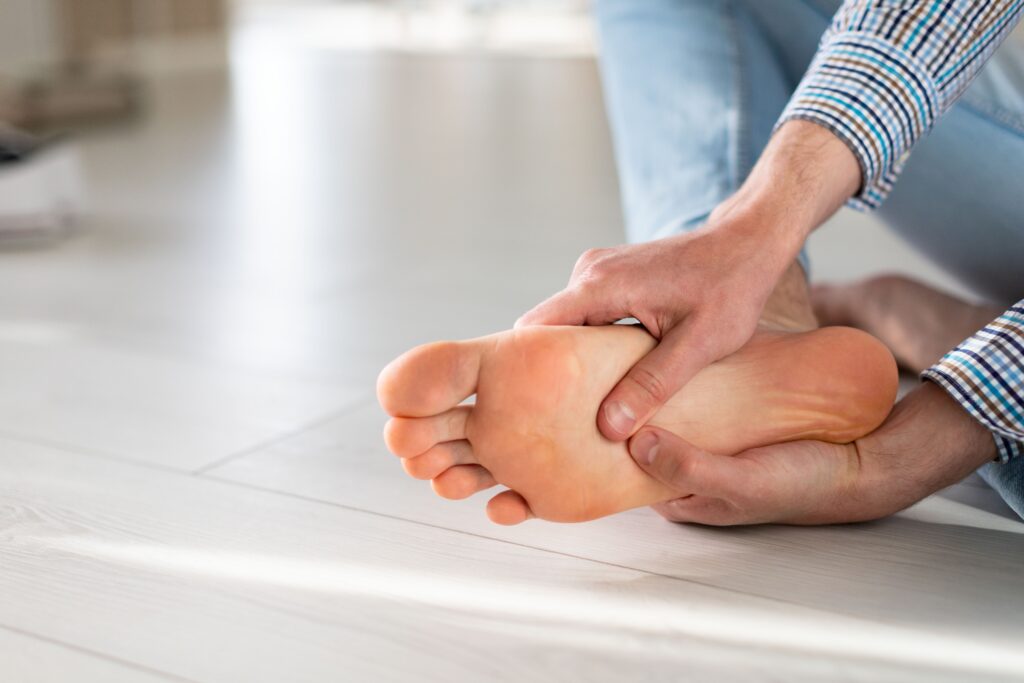
Key Takeaways
- Plantar fasciitis is one of the most common causes of pain beneath the heel. It typically involves a painful overload condition affecting the plantar fascia near its attachment to the heel bone.
- Pain with the first steps after getting out of bed is a characteristic symptom. Discomfort may temporarily improve after walking, then return with prolonged standing or activity.
- Despite the name, plantar fasciitis is not always primarily an inflammatory condition. The term plantar fasciopathy is often used to describe the degenerative and load-related changes associated with persistent symptoms.
- Limited ankle dorsiflexion, calf tightness, increased loading, and footwear can contribute, but no single foot shape, posture, or mechanical finding explains every case.
- Most patients can begin with conservative treatment. Progressive loading exercises, plantar fascia stretching, appropriate footwear, and selected supportive interventions may improve symptoms and function.
- A heel spur on an X-ray does not automatically explain heel pain. Spurs are common in people without symptoms and do not necessarily require removal.
- Not all heel pain is plantar fasciitis. Nerve entrapment, stress fractures, heel fat-pad disorders, inflammatory arthritis, and other conditions must be considered when the presentation is atypical.
“The First Few Steps in the Morning Are Terrible.”
A patient may describe a familiar pattern:
“When I first get out of bed, I can barely put my heel on the floor. After I walk around for a few minutes, it loosens up. But if I sit down for a while and get back up, it starts hurting again.”
Another patient may notice that the heel feels relatively comfortable during the morning but becomes increasingly painful after a long day of standing.
Others experience both patterns.
They may be able to continue walking once the foot warms up, yet develop substantial pain after working, shopping, or exercising.
This pattern often raises suspicion for plantar fasciitis.
However, the important question is not simply whether the heel hurts.
It is which structure is responsible for the pain and why that structure is being overloaded.
What Is the Plantar Fascia?
The plantar fascia is a thick band of connective tissue along the bottom of the foot.
It extends from the heel region toward the forefoot and helps support the foot during standing and walking.
Its functions include:
- Supporting the longitudinal arch
- Helping distribute forces through the foot
- Contributing to foot stability
- Participating in energy storage and release during walking and running
The plantar fascia is not a muscle.
It is a strong connective tissue structure that experiences substantial mechanical loading during everyday activity.
Near its attachment to the heel bone, the tissue may become painful when its capacity to tolerate loading is exceeded.
This is a common mechanism associated with plantar heel pain.
Why the Pain Is Usually Near the Inside of the Heel
Many patients with plantar fasciitis experience tenderness near the medial plantar calcaneal region.
This is the area along the bottom and slightly inner side of the heel where part of the plantar fascia originates.
Patients may point to a relatively specific location.
They may say:
“It hurts right here, just in front of the heel.”
Pain may also extend into the arch.
The precise location helps distinguish plantar fascia-related pain from other heel disorders.
For example, pain directly in the center of the heel may raise greater suspicion for a heel fat-pad problem.
Burning or tingling may suggest nerve involvement.
Pain around the back of the heel may involve the Achilles tendon or adjacent structures.
The location is important, but it is not sufficient to establish the diagnosis by itself.
Why Plantar Fasciitis Hurts Most With the First Steps
The characteristic morning pain pattern is sometimes called first-step pain.
During sleep, the foot is generally unloaded for an extended period.
When the patient stands, the plantar fascia is suddenly required to tolerate body weight and the forces associated with walking.
A sensitized or overloaded plantar fascia may respond with sharp pain.
After several minutes of movement, symptoms may become less intense.
However, that temporary improvement does not necessarily mean the tissue has healed.
The foot may still have reduced tolerance for prolonged or repetitive loading.
This explains why symptoms can return later in the day.
The Same Problem Can Occur After Sitting
Morning pain is common, but the same pattern can occur after any prolonged period of rest.
A patient may notice heel pain after:
- Sitting through a movie
- Driving for an hour
- Working at a desk
- Eating dinner
- Resting after exercise
The first few steps may be uncomfortable.
Then the pain may gradually settle.
This pattern is often described as post-static dyskinesia, meaning pain or stiffness after a period of inactivity.
It is a useful clinical clue, although other musculoskeletal conditions can produce similar symptoms.
Plantar Fasciitis Versus Plantar Fasciopathy
The terms are often used interchangeably, but they are not identical in emphasis.
Plantar fasciitis is the familiar clinical term for plantar fascia-related heel pain.
The suffix -itis traditionally implies inflammation.
However, chronic plantar heel pain often involves changes in tissue structure and load tolerance rather than a purely inflammatory process.
For this reason, the term plantar fasciopathy is frequently used in contemporary clinical discussions.
The distinction matters because treatment should not focus exclusively on suppressing inflammation.
Long-term improvement often requires restoring the tissue’s ability to tolerate everyday loading.
Why Plantar Fasciitis Develops
Plantar heel pain often develops when the demands placed on the foot exceed the capacity of the plantar fascia and associated structures.
This may occur gradually.
A patient may not remember a specific injury.
Instead, symptoms develop after changes in:
- Walking volume
- Running activity
- Standing duration
- Exercise intensity
- Footwear
- Work demands
- Body weight
- Recovery time
For example, someone who normally works at a desk may develop heel pain after starting a job that requires standing for eight hours.
Another patient may begin a new walking program and increase mileage too quickly.
The problem is not necessarily that walking is harmful.
It may be that the tissue was exposed to more loading than it could currently tolerate.
Increased Activity Is Not the Only Risk Factor
Although activity changes are important, plantar fasciitis can develop without a recent increase in exercise.
Other associated factors include:
- Reduced ankle dorsiflexion
- Limited calf flexibility
- Higher body mass
- Prolonged occupational standing
- Certain repetitive loading activities
- Previous episodes of plantar heel pain
Some patients have multiple contributing factors.
Others have no obvious single explanation.
The condition should not automatically be blamed on one mechanical abnormality.
Does Having Flat Feet Cause Plantar Fasciitis?
Foot structure can influence how forces are distributed during standing and walking.
However, having flat feet does not automatically mean a person will develop plantar fasciitis.
Many individuals with low arches never experience heel pain.
Likewise, people with relatively high arches can develop plantar fascia-related symptoms.
Foot posture is one factor among many.
A useful examination considers the patient’s:
- Symptoms
- Activity demands
- Ankle mobility
- Foot function
- Strength
- Footwear
- Overall loading history
The goal is not to identify an imperfect-looking arch and assume it explains everything.
Can High Arches Contribute to Heel Pain?
Some patients with higher arches may experience different patterns of pressure distribution and loading.
However, a high arch is not automatically pathological.
The clinical significance depends on the individual’s symptoms, movement, and activity demands.
A patient with high arches and heel pain may benefit from evaluation of footwear and load tolerance.
Another patient with the same arch shape may require no intervention.
Foot structure should be interpreted in context rather than treated as a diagnosis.
The Relationship Between the Calf and Plantar Fascia
The calf muscles and Achilles tendon influence ankle movement and loading during walking.
When ankle dorsiflexion is limited, the foot and lower extremity may compensate in different ways.
Reduced dorsiflexion has been associated with plantar heel pain in some patients.
This is one reason calf mobility is commonly evaluated.
However, calf tightness is not necessarily the primary cause of every case.
A patient may have normal ankle mobility and still develop plantar fasciopathy.
Treatment should address the impairments actually identified during examination.
Why Standing All Day Can Aggravate Heel Pain
The plantar fascia experiences repeated loading throughout the day.
For someone who works in retail, healthcare, manufacturing, or another standing-intensive occupation, the cumulative demand may be substantial.
Patients may notice that symptoms worsen during:
- Long shifts
- Walking on hard floors
- Repeated lifting and carrying
- Extended periods without rest
This does not mean the patient must permanently avoid standing.
It means the current loading demand may need to be adjusted while the tissue’s tolerance improves.
Footwear, scheduled breaks, strengthening, and other individualized strategies may help.
Running and Plantar Fasciitis
Running places repetitive forces through the foot.
Plantar heel pain may develop when training demands increase beyond the individual’s current capacity.
Potential contributing changes include:
- Increased mileage
- More frequent running
- Faster workouts
- Hill training
- Changes in footwear
- Reduced recovery
A runner may notice that the heel hurts during the first few minutes, improves as the run continues, and becomes more painful afterward.
That temporary improvement during exercise should not be interpreted as proof that continued loading is harmless.
The appropriate response depends on symptom severity, tissue irritability, and the overall clinical presentation.
Should You Stop Walking or Running Completely?
Not necessarily.
Complete inactivity is often unnecessary for uncomplicated plantar fasciopathy.
However, continuing activities that repeatedly produce substantial pain may delay improvement.
A more useful approach is load management.
That may involve temporarily adjusting:
- Distance
- Duration
- Frequency
- Intensity
- Terrain
- Footwear
The objective is to maintain appropriate activity while reducing excessive stress on the painful tissue.
As symptoms improve, activity can be progressively increased.
Why Barefoot Walking May Hurt More
Some patients notice that their heel pain becomes worse when walking barefoot on hard floors.
Without footwear, the foot may experience different pressure distribution and loading.
For a sensitive plantar fascia, this can be uncomfortable.
Supportive shoes or other temporary modifications may help reduce symptoms.
However, barefoot walking is not inherently harmful for every person.
The important question is whether it aggravates the patient’s current condition.
During a painful episode, temporarily avoiding barefoot walking on hard surfaces may be reasonable.
Does the Type of Shoe Matter?
Footwear can influence comfort and load distribution.
Some patients improve when switching from worn-out or minimally supportive shoes to footwear that provides a more comfortable combination of:
- Cushioning
- Fit
- Stability
- Heel support
- Appropriate flexibility
There is no single shoe design that works for every patient with plantar fasciitis.
A shoe that feels comfortable for one person may aggravate another.
The best choice should account for the patient’s foot shape, activities, and symptom response.
Heel Spurs: A Common Source of Confusion
Patients frequently arrive with an X-ray report mentioning a plantar calcaneal spur.
They may say:
“My doctor told me I have a heel spur. Is that what’s stabbing me every morning?”
A heel spur is a bony projection that may develop near the underside of the calcaneus.
It can be associated with chronic loading and degenerative changes around the heel.
However, heel spurs are also found in people who have no heel pain.
Therefore, the presence of a spur does not prove that it is causing the symptoms.
A Heel Spur Does Not Automatically Need to Be Removed
The idea that heel pain is caused by a sharp piece of bone stabbing into the foot is often misleading.
In many patients, the pain is more closely associated with the plantar fascia and surrounding tissues.
A patient may have a large spur without significant pain.
Another may have classic plantar fasciitis symptoms without a visible spur.
Treatment decisions should be based on the clinical diagnosis rather than the spur alone.
Most patients with plantar fasciitis do not require surgery to remove a heel spur.
When Heel Pain May Be Something Other Than Plantar Fasciitis
Although plantar fasciitis is common, other conditions can produce pain in the heel.
Important possibilities include:
- Calcaneal stress fracture
- Heel fat-pad syndrome
- Tarsal tunnel syndrome
- Baxter nerve entrapment
- Achilles tendinopathy
- Inflammatory arthritis
- Other local or systemic conditions
These disorders may overlap in their symptoms.
A patient with an atypical presentation should not automatically receive plantar fascia treatment without considering alternatives.
Heel Fat-Pad Syndrome
The heel contains specialized fatty tissue that helps cushion impact.
When this tissue becomes painful or loses some of its shock-absorbing capacity, patients may experience discomfort directly beneath the center of the heel.
Pain may be particularly noticeable during prolonged standing or walking on hard surfaces.
Unlike classic plantar fasciitis, which commonly produces tenderness near the inner plantar heel, fat-pad pain may be more centrally located.
The distinction matters because the treatment emphasis may differ.
Cushioning and pressure modification may be particularly relevant for heel fat-pad symptoms.
Calcaneal Stress Fracture
A stress fracture of the heel bone can produce pain during weight-bearing activity.
It may develop after increased repetitive loading, particularly in runners or individuals who have recently increased activity.
Risk can also be influenced by bone health and other medical factors.
A patient may report:
- Increasing heel pain with activity
- Difficulty bearing weight
- Pain that does not follow the typical first-step pattern
- Localized bony tenderness
Stress fractures may not be visible on early X-rays.
When the history and examination raise concern, additional imaging and medical evaluation may be necessary.
Continuing aggressive stretching or loading exercises without excluding a stress fracture could worsen the condition.
Nerve Entrapment Can Produce Burning Heel Pain
Some patients describe heel pain as:
- Burning
- Electric
- Tingling
- Shooting
These symptoms may raise suspicion for nerve involvement.
Potential causes include tarsal tunnel syndrome or entrapment of branches of the tibial nerve.
However, burning pain alone does not establish a nerve disorder.
Some patients with plantar fasciopathy also use the word burning to describe their discomfort.
The neurological examination and symptom distribution help distinguish the possibilities.
Could Heel Pain Be Coming From the Lower Back?
Yes, in selected cases.
Lumbar nerve-root disorders can produce pain, tingling, or numbness extending into the foot.
However, classic plantar fasciitis typically produces localized plantar heel tenderness and a recognizable loading-related pattern.
A patient with heel pain accompanied by:
- Radiating leg symptoms
- Numbness
- Weakness
- Back pain
- Neurological changes
may require evaluation of the lumbar spine and peripheral nervous system.
It is also possible to have plantar fasciitis and lumbar radiculopathy at the same time.
One diagnosis does not automatically exclude the other.
When Inflammatory Arthritis Should Be Considered
Heel pain can occasionally be associated with systemic inflammatory conditions.
For example, certain inflammatory arthritides may involve painful inflammation at tendon or ligament attachment sites, a process called enthesitis.
Clues that may raise concern include:
- Pain involving multiple attachment sites
- Significant prolonged morning stiffness
- Other swollen joints
- Inflammatory back pain
- Psoriasis
- Inflammatory bowel disease
- Other systemic symptoms
These findings may justify medical or rheumatological evaluation.
Not every patient with morning heel pain has an inflammatory disorder, but the possibility should be considered when the broader history suggests it.
Is Imaging Necessary for Plantar Fasciitis?
Not always.
Many patients with a typical history and examination can be diagnosed clinically.
Imaging may become more useful when:
- The presentation is atypical
- A stress fracture is suspected
- Symptoms persist despite appropriate care
- Significant trauma has occurred
- Another structural condition is being considered
X-rays can help evaluate certain bony abnormalities.
Ultrasound or MRI may be considered in selected cases when more detailed soft-tissue assessment is necessary.
The decision should be based on the diagnostic question rather than the assumption that every painful heel requires imaging.
Why Treatment Should Focus on More Than Reducing Inflammation
Patients often assume plantar fasciitis is simply an inflamed ligament that needs rest and anti-inflammatory medication.
But persistent plantar heel pain commonly involves impaired load tolerance.
That means a treatment plan may need to address both symptom reduction and gradual restoration of tissue capacity.
For appropriately selected patients, conservative management may include:
- Plantar fascia-specific stretching
- Calf stretching when indicated
- Progressive strengthening
- Activity modification
- Footwear changes
- Orthoses or taping in selected cases
- Other evidence-informed interventions
The objective is to improve the patient’s ability to walk, stand, exercise, and perform daily activities.
Temporary pain relief is useful, but it should support a longer-term recovery strategy.
The Most Important Question Is Not Simply “How Do I Get Rid of My Heel Spur?”
A useful clinical evaluation asks:
Does the pain pattern fit plantar fasciitis?
Is the tenderness located near the plantar fascia attachment?
Are there findings suggesting a stress fracture, nerve entrapment, or another diagnosis?
Has the patient recently increased standing, walking, or running?
Are ankle mobility, strength, footwear, or loading demands contributing?
Would imaging change the diagnosis or treatment?
What combination of load management, rehabilitation, and supportive care is appropriate?
And how will we determine whether the patient’s walking and standing tolerance are actually improving?
Those questions turn a common heel complaint into an individualized treatment plan.
How Doyle Chiropractic Evaluates Plantar Fasciitis and Persistent Heel Pain
When a patient comes to Doyle Chiropractic with pain beneath the heel, the first priority is determining whether the symptoms are consistent with plantar fasciitis or whether another condition may be responsible.
Dr. Geoffrey Doyle evaluates the relationship between the patient’s symptoms, activity history, foot mechanics, ankle mobility, and examination findings.
A typical presentation may include tenderness near the inner portion of the plantar heel, pain with the first steps after rest, and increased discomfort following prolonged standing or walking.
However, not every painful heel follows that pattern.
A patient with burning, tingling, or numbness may require a more detailed neurological examination. Someone with increasing pain after a sudden change in running volume may need evaluation for a calcaneal stress fracture. A patient with central heel tenderness may have a problem involving the heel’s protective fat pad.
The objective is to establish the most likely diagnosis before selecting treatment.
The physical examination
Depending on the presentation, the examination may assess:
- The location of heel tenderness
- Plantar fascia sensitivity
- Ankle dorsiflexion
- Calf flexibility
- Foot and ankle strength
- Great-toe mobility
- Walking mechanics
- Balance and lower-extremity function
- Neurological findings when indicated
The clinician may also evaluate whether loading the plantar fascia reproduces the patient’s familiar symptoms.
For example, passive extension of the great toe can increase tension through the plantar fascia. In some patients, this reproduces pain near the heel.
This is sometimes called the windlass test.
A positive response may support the diagnosis, but no single examination maneuver definitively establishes plantar fasciitis.
The findings should be interpreted together.
The First Treatment Goal Is to Reduce Excessive Loading Without Eliminating Activity
For most patients with uncomplicated plantar fasciitis, conservative treatment is appropriate.
However, the plan should reflect the patient’s actual activities and symptom severity.
A patient who works eight hours a day on concrete floors has different demands from someone who developed heel pain after increasing their running mileage.
Both may have plantar fasciopathy, but their treatment programs should not necessarily be identical.
Early management may involve temporarily modifying the activities that repeatedly aggravate symptoms.
This does not mean avoiding all walking.
It means finding a level of activity the patient can tolerate while the painful tissue begins to recover.
For example, a patient may benefit from shorter walking intervals, supportive footwear, or temporarily reducing high-impact exercise.
As symptoms improve, activity can be gradually increased.
The goal is to restore normal loading capacity rather than maintain permanent activity restrictions.
Plantar Fascia-Specific Stretching
One of the better-supported conservative interventions for plantar fasciitis is stretching directed specifically at the plantar fascia.
Unlike a general calf stretch, this technique places controlled tension through the tissue along the bottom of the foot.
A common method involves gently extending the toes toward the shin while supporting the foot.
The patient may feel tension through the arch.
The stretch should be controlled rather than forceful.
For some patients, performing plantar fascia-specific stretching before taking the first steps in the morning may help reduce discomfort.
It may also be useful after prolonged sitting.
However, the appropriate duration and frequency should be individualized.
Stretching should not produce sharp or progressively worsening pain.
Why stretching alone may not be enough
Stretching can improve symptoms, but it does not necessarily restore the tissue’s ability to tolerate prolonged standing, walking, or running.
A patient may feel better after stretching and still experience substantial heel pain later in the day.
That is why a complete rehabilitation program often includes progressive strengthening and load management.
Calf Stretching and Ankle Mobility
The calf muscles and Achilles tendon influence how the ankle moves during walking.
Some patients with plantar fasciitis demonstrate reduced ankle dorsiflexion.
When that limitation is clinically relevant, calf stretching or other mobility exercises may be appropriate.
Treatment may address both the gastrocnemius and soleus muscles because ankle position and knee position influence how these muscles are stretched.
However, not every patient with plantar fasciitis has restricted ankle mobility.
The purpose of the examination is to identify whether this is a meaningful impairment rather than automatically prescribing the same stretching program to everyone.
Excessively aggressive stretching may aggravate symptoms.
The appropriate intensity should be guided by comfort and response.
Progressive Strengthening Helps Restore Load Tolerance
The plantar fascia works alongside muscles and other structures that support the foot during standing and walking.
Rehabilitation may incorporate progressive strengthening of the foot and lower extremity.
Depending on the patient’s condition, exercises may include:
- Controlled heel raises
- Progressive calf strengthening
- Foot intrinsic muscle exercises
- Balance activities
- Functional lower-extremity strengthening
Heel raises are particularly relevant because they progressively load the calf-Achilles-plantar fascia system.
Some rehabilitation programs incorporate a modified heel raise performed with the toes extended over a small towel.
This increases loading through the plantar fascia.
However, that exercise may be too provocative for some patients early in treatment.
The correct progression depends on the patient’s symptoms, strength, and current load tolerance.
The objective is not to force the fascia through pain. It is to progressively increase the amount of loading the foot can tolerate.
Why the Entire Lower Extremity May Need Attention
Although plantar fasciitis produces localized heel pain, walking and running involve coordinated movement throughout the lower extremity.
The hips, knees, ankles, and feet all contribute to force absorption and propulsion.
For selected patients, rehabilitation may address:
- Hip strength
- Calf endurance
- Single-leg balance
- Walking mechanics
- Lower-extremity coordination
This does not mean that weak hip muscles are necessarily the cause of plantar fasciitis.
It means that improving overall physical capacity may help a patient return to demanding activities.
For example, a runner returning to higher mileage may require a broader conditioning program than someone whose primary goal is comfortable household walking.
Footwear and Orthotics: Support Without Overpromising
Footwear can be an important part of symptom management.
Some patients experience relief when they switch to shoes that provide better cushioning, fit, and support.
Others benefit from temporary modifications such as heel cups or foot orthoses.
However, orthotics should not be presented as a universal correction for an improperly aligned foot.
Research suggests that foot orthoses may provide modest symptom relief for some patients, particularly as part of a broader treatment program.
Custom orthotics are not automatically superior to prefabricated devices for every patient.
The decision should consider:
- Foot shape
- Symptom location
- Activity demands
- Footwear compatibility
- Comfort
- Previous treatment response
Orthoses may help redistribute loading, but they do not eliminate the need for appropriate rehabilitation.
Taping Can Provide Short-Term Relief
Foot taping is another conservative intervention sometimes used for plantar heel pain.
Techniques such as low-Dye taping may temporarily alter loading and provide support to the foot.
Some patients experience reduced discomfort during walking or standing.
However, taping is generally considered a short-term symptom-management strategy.
It does not permanently change foot anatomy or restore tissue capacity.
Taping may be particularly useful while a patient transitions to more comfortable footwear or begins a strengthening program.
Skin sensitivity and adhesive reactions should also be considered.
Night Splints and Morning First-Step Pain
For patients whose most prominent symptom is severe pain with the first steps in the morning, a night splint may be considered.
Night splints are designed to maintain the ankle and sometimes the toes in a position that limits prolonged plantarflexion during sleep.
The objective is to reduce the discomfort associated with suddenly loading the plantar fascia after rest.
Some patients experience improvement.
Others find the splint uncomfortable or difficult to tolerate during sleep.
Night splints are not necessary for every patient with plantar fasciitis.
They are generally considered an adjunct to stretching, rehabilitation, and other appropriate conservative measures, particularly when morning first-step pain remains persistent.
The Role of Chiropractic and Manual Treatment
Chiropractic or manual treatment may be incorporated into a conservative program for selected patients with plantar heel pain.
Depending on examination findings, treatment may address relevant musculoskeletal impairments involving the:
- Foot
- Ankle
- Calf
- Lower extremity
Manual techniques may include joint mobilization or soft-tissue treatment when clinically appropriate.
The purpose is to improve comfort and movement, potentially making rehabilitation easier.
However, manual treatment should not be described as breaking apart scar tissue, permanently correcting the arch, or removing a heel spur.
The evidence supports considering manual therapy as one component of a broader conservative approach rather than relying on it as a stand-alone cure.
Soft-Tissue Treatment and Cupping
Some patients with plantar fasciitis also experience discomfort or muscular restrictions involving the calf and surrounding tissues.
Soft-tissue techniques may be used as adjuncts when examination findings support their use.
These may include manual soft-tissue treatment or other selected techniques.
Cupping is sometimes used for musculoskeletal symptoms, but evidence specifically supporting cupping for plantar fasciitis is limited.
It should not be presented as a treatment that repairs the plantar fascia or reverses chronic degenerative tissue changes.
When soft-tissue treatment is incorporated, its value should be assessed through improvements in symptoms and function.
It should support the rehabilitation program rather than replace it.
Class IV Laser Therapy
Class IV laser therapy may be considered as an adjunct for selected musculoskeletal conditions.
Photobiomodulation has been investigated for plantar heel pain, and some studies suggest potential short-term benefits for pain and function.
However, the research varies in treatment parameters, device characteristics, and study quality.
Evidence for laser therapy in general should not automatically be interpreted as proof that a particular Class IV device or treatment protocol produces the same results.
Laser therapy has not been established as a method of regenerating the plantar fascia, removing heel spurs, or permanently correcting the underlying loading problem.
If used, it should complement an appropriate rehabilitation and load-management program.
Shockwave Therapy for Persistent Plantar Fasciitis
Extracorporeal shockwave therapy, commonly called ESWT, is a nonsurgical treatment that delivers acoustic energy to the affected region.
It has been studied for chronic plantar fasciopathy, particularly when symptoms persist despite initial conservative care.
Research suggests that shockwave therapy may improve pain and function in selected patients.
However, results vary depending on:
- Patient selection
- Treatment protocol
- Device characteristics
- Symptom duration
- Comparison treatment
Shockwave therapy does not remove heel spurs or guarantee complete recovery.
It may be considered as an additional treatment option for persistent cases after an appropriate evaluation.
Anti-Inflammatory Medication and Pain Management
Some patients use over-the-counter pain medications to manage plantar heel pain.
Depending on the patient’s medical history, a prescribing clinician may recommend certain medications for short-term symptom relief.
However, persistent plantar fasciopathy is not necessarily a purely inflammatory condition.
Medication alone may not address the underlying loading intolerance.
Nonsteroidal anti-inflammatory medications also carry potential gastrointestinal, kidney, cardiovascular, and other risks.
Patients should use medications according to appropriate medical guidance, particularly when other health conditions or medications are involved.
Corticosteroid Injections: Benefits and Limitations
Corticosteroid injections are sometimes considered for persistent plantar heel pain.
They may provide short-term symptom relief in selected patients.
However, injections also carry risks.
Potential complications include:
- Plantar fascia rupture
- Heel fat-pad injury or atrophy
- Infection
- Other local adverse effects
Repeated injections may increase concern about tissue-related complications.
For these reasons, corticosteroid injections should not automatically be considered the next step for every patient whose heel pain persists.
A medical specialist can help evaluate whether an injection is appropriate and discuss alternatives.
When Surgery May Be Considered
Most patients with plantar fasciitis do not require surgery.
However, a small proportion develop persistent, substantially limiting symptoms despite an appropriate course of nonsurgical treatment.
In selected cases, a foot and ankle specialist may consider surgical options.
These may include procedures involving the plantar fascia or, in certain circumstances, the gastrocnemius muscle.
The appropriate procedure depends on the diagnosis, anatomy, and contributing factors.
Surgery carries risks, including persistent pain, nerve injury, altered foot mechanics, and other complications.
It is generally reserved for carefully selected patients after reasonable conservative treatment has failed.
A heel spur alone is not an indication for surgery.
The Dr. Doyle Perspective
“When someone comes in telling me they have a heel spur or plantar fasciitis, I want to know exactly where the pain is and when it occurs. That first-step pain in the morning is a useful clue, but it doesn’t tell us everything. I also want to know what they’re doing all day. Are they standing on concrete for eight hours? Did they suddenly start walking three miles every morning? Have they changed shoes? The important thing is understanding why the tissue is being overloaded and helping the foot tolerate those activities again. We may use several conservative treatments to make the patient more comfortable, but I don’t want them depending on temporary relief alone. I want them to get back to walking, exercising, and doing the things they enjoy.”
— Dr. Geoffrey Doyle, DC
Our Clinical Experience
Consider several patients who come to the office with heel pain.
The first patient reports sharp discomfort near the inner plantar heel with the first steps each morning.
The pain improves after several minutes but returns following prolonged standing.
The examination reproduces familiar tenderness near the plantar fascia attachment.
That presentation is consistent with plantar fasciitis and may be appropriate for conservative treatment.
A second patient develops heel pain after rapidly increasing running mileage.
The discomfort becomes progressively worse with activity, and examination raises concern for a calcaneal stress injury.
That patient may require imaging and medical evaluation before beginning a loading program.
A third patient reports burning and tingling along the sole of one foot.
The symptoms do not follow a typical first-step pattern.
That presentation raises consideration of peripheral nerve involvement and requires a different diagnostic approach.
A fourth patient has persistent plantar fasciopathy despite an appropriate rehabilitation program.
The symptoms continue to interfere substantially with work and walking.
That patient may benefit from additional evaluation and consideration of other evidence-informed treatment options.
These examples illustrate why heel pain is a symptom, not a complete diagnosis.
The appropriate treatment depends on identifying the involved structure and the factors contributing to the condition.
How Long Does Plantar Fasciitis Take to Improve?
Recovery varies considerably.
Some patients improve within several weeks of appropriate conservative care.
Others experience symptoms for several months or longer.
Factors that may influence recovery include:
- Symptom duration
- Severity
- Occupational standing demands
- Activity levels
- Associated medical conditions
- Response to load modification
- Adherence to rehabilitation
Persistent symptoms do not automatically mean the patient needs surgery.
However, a lack of meaningful improvement should prompt reassessment of the diagnosis and treatment plan.
The objective is to establish measurable progress rather than continue the same interventions indefinitely.
How We Measure Improvement
Pain intensity is one important measure, but it is not the only one.
For plantar fasciitis, meaningful progress may include:
- Less pain with the first steps in the morning
- Improved standing tolerance
- Greater walking distance
- Reduced pain after work
- Better tolerance for exercise
- Improved foot and calf strength
- Reduced reliance on symptom-relief measures
A patient whose morning pain decreases but who still cannot stand through a normal work shift may need additional rehabilitation.
Likewise, a patient who can walk farther without a substantial increase in symptoms may be improving even if occasional tenderness remains.
The goal is restoration of meaningful function.
Preventing Recurrence
Once symptoms improve, patients may benefit from maintaining an appropriate level of physical activity and gradually progressing loading demands.
Practical strategies may include:
- Continuing relevant strengthening exercises
- Increasing walking or running volume gradually
- Wearing comfortable footwear for demanding activities
- Managing abrupt changes in standing duration
- Maintaining calf and ankle mobility when appropriate
- Responding early to recurring symptoms
No prevention strategy guarantees that plantar fasciitis will never return.
However, improving physical capacity and avoiding abrupt increases in loading may reduce the likelihood of recurring problems.
When Heel Pain Needs Additional Medical Evaluation
Patients should seek additional evaluation when symptoms are unusual, persistent, or accompanied by concerning findings.
Examples include:
- Severe pain following trauma
- Inability to bear weight
- Significant swelling
- Progressive numbness or weakness
- Suspected stress fracture
- Persistent pain that does not improve with appropriate treatment
- Fever, redness, or signs of infection
- Significant unexplained systemic symptoms
A patient with diabetes and reduced foot sensation should also receive appropriate medical evaluation for wounds, skin changes, or possible infection.
Sudden severe pain associated with major neurological or vascular changes requires urgent or emergency assessment.
Routine plantar fascia treatment should not delay investigation of a more serious condition.
Frequently Asked Questions
What is plantar fasciitis?
Plantar fasciitis is a common cause of pain beneath the heel associated with irritation or impaired load tolerance of the plantar fascia, particularly near its attachment to the heel bone.
Why does plantar fasciitis hurt most in the morning?
After a period of rest, the plantar fascia is suddenly loaded when standing and walking. In a sensitive or overloaded tissue, this can produce sharp first-step pain.
Why does my heel feel better after walking for a few minutes?
Movement may temporarily reduce stiffness and pain sensitivity. However, symptom improvement after warming up does not necessarily mean the underlying condition has healed.
Can plantar fasciitis cause pain in the arch?
Yes. Although pain is commonly concentrated near the plantar heel, discomfort may extend into the arch along the plantar fascia.
Is plantar fasciitis caused by inflammation?
Inflammation may contribute in some cases, but persistent plantar fasciopathy often involves load-related and degenerative tissue changes rather than a purely inflammatory process.
Does plantar fasciitis mean I have a heel spur?
No. Heel spurs may coexist with plantar fasciitis, but many patients with plantar fasciitis have no significant spur, and many people with heel spurs have no pain.
Do heel spurs need to be removed?
Usually not. Most patients with plantar heel pain can begin with conservative management, and the presence of a spur alone does not justify surgery.
Should I stop walking if I have plantar fasciitis?
Not necessarily. Activity may need to be modified according to symptom severity. Shorter walking intervals and gradual progression may be more appropriate than complete inactivity.
Is it better to wear shoes or go barefoot?
Some patients with plantar fasciitis experience greater discomfort when walking barefoot on hard surfaces. Comfortable, supportive footwear may help during a painful episode.
Do orthotics help plantar fasciitis?
Orthoses may provide modest symptom relief for some patients, particularly as part of a broader conservative program. Custom orthotics are not automatically necessary for everyone.
Can stretching help plantar fasciitis?
Yes. Plantar fascia-specific stretching and calf stretching when indicated are commonly recommended components of conservative treatment.
Are heel raises good for plantar fasciitis?
Progressive heel-raise exercises may help improve load tolerance and lower-extremity strength. The exercise should be introduced at an appropriate intensity based on symptoms and functional capacity.
Can chiropractic treatment help plantar fasciitis?
Selected patients may benefit from a conservative program incorporating rehabilitation, appropriate manual treatment, and activity modification. Treatment should be based on the clinical diagnosis and should not promise to remove heel spurs or permanently correct foot structure.
Can Class IV laser therapy help plantar fasciitis?
Photobiomodulation has shown potential symptom benefits in some studies, but evidence varies and does not establish that a specific Class IV laser protocol reliably cures plantar fasciitis. It may be considered as an adjunct when appropriate.
Does shockwave therapy work for plantar fasciitis?
Shockwave therapy may improve pain and function in selected patients with persistent plantar fasciopathy. Results vary, and it is not necessary for every patient.
Are cortisone injections good for plantar fasciitis?
Corticosteroid injections may provide short-term relief in selected patients, but they carry risks, including plantar fascia rupture and heel fat-pad injury. The decision requires individualized medical assessment.
How can I tell if my heel pain is a stress fracture?
A stress fracture may produce increasing pain with weight-bearing activity and localized bony tenderness, sometimes without the typical first-step pattern. Imaging may be necessary when a stress fracture is suspected.
Can plantar fasciitis cause numbness or tingling?
Classic plantar fasciitis primarily produces mechanical heel pain. Prominent numbness, tingling, or electric sensations may suggest nerve involvement or another condition requiring evaluation.
How long does plantar fasciitis last?
Some patients improve within weeks, while others have symptoms lasting months or longer. Recovery depends on the individual condition, activity demands, and response to treatment.
When is surgery necessary?
Surgery is rarely the first treatment for plantar fasciitis. It may be considered for carefully selected patients with persistent, disabling symptoms despite an appropriate course of nonsurgical care.
Can plantar fasciitis come back after treatment?
Yes. Symptoms can recur, particularly when loading demands increase abruptly or contributing factors remain unaddressed. Progressive strengthening and appropriate activity management may help reduce recurrence risk.