Expertise provided by Dr. Doyle, Geoffrey A Doyle
A patient walks in expecting adjustments to fix everything. Dr. Doyle palpates the spine, checks how the joints move, and finds the real problem goes beyond a locked vertebra. There is a disc that needs space and muscle tissue that needs repair. The plan changes on the spot, and so does the outcome. That is how pain management works at Doyle Chiropractic: find the tissue, match the treatment, and work toward addressing the injured tissues. If your back pain, neck pain, sciatica, or headaches keep coming back no matter what you try, chiropractic pain management in Huntersville should start in the same place. It should start with an exam that finds which tissues are actually injured, not just where it hurts.
What Is Chiropractic Pain Management in Huntersville, and How Is It Different From a Medical Pain Clinic?
Chiropractic pain management is a drug-free approach. It finds which tissues are injured and then layers treatments to address them. Those tissues can be joints, muscles, ligaments, tendons, discs, nerves, fascia, or bone. A medical pain clinic usually works to quiet the pain with medication or injections. That can help you through a rough stretch, but it is not built around addressing the tissue underneath.
Think of it like the check engine light in your car. You can put a piece of tape over the light so you stop seeing it, and that has its place when you just need to get home. But the light came on for a reason, and until somebody opens the hood and addresses the part that failed, it keeps coming back. Pain works the same way. At Doyle Chiropractic, each tool is matched to a tissue:
- Adjustments restore motion to a restricted joint.
- Class 4 laser helps support tissue that is actually injured.
- Acupuncture helps address pain and symptoms.
- Decompression makes room for a disc or nerve that is getting squeezed.
The research supports the hands-on part of this. The NIH’s National Center for Complementary and Integrative Health reports that spinal manipulation may help low back pain. It has also been studied for neck pain and headaches, and its side effects, like temporary soreness, are usually mild and short-lived. Harvard Health points out that guidelines from the American College of Physicians recommend trying nondrug options for low back pain, including spinal manipulation, before medication.
None of this means you skip your medical doctor. Sometimes the exam turns up something that needs a medical workup, and when it does, that becomes part of the game plan too. The difference is the goal. At Doyle Chiropractic, the goal is not to help you live with the pain. It is to address the tissue with the goal of reducing pain at its source.
Will Anyone Actually Listen? What Your First Visit Looks Like and How Dr. Doyle Finds the Tissue Causing Your Pain
So what does that look like in practice? Your first visit at Doyle Chiropractic is a sit-down conversation followed by a hands-on exam. You leave knowing which tissues are causing your pain, how serious the problem is, and what your treatment options are. You are never pushed to sign up that day.
It starts the old-fashioned way. Dr. Doyle knocks, greets you by name, shakes your hand, and thanks you for the referral if someone sent you. He goes over your paperwork with you and then asks you to tell your story in your own words: what bothers you most, when it started, what makes it worse, and what you have already tried. He breaks down each symptom one at a time. Often times the paperwork only tells half the story. Exam findings like tight and tender fibers, heat, guarding, and restricted joint movement can show that a problem has been building for years and is more involved than the forms suggest.
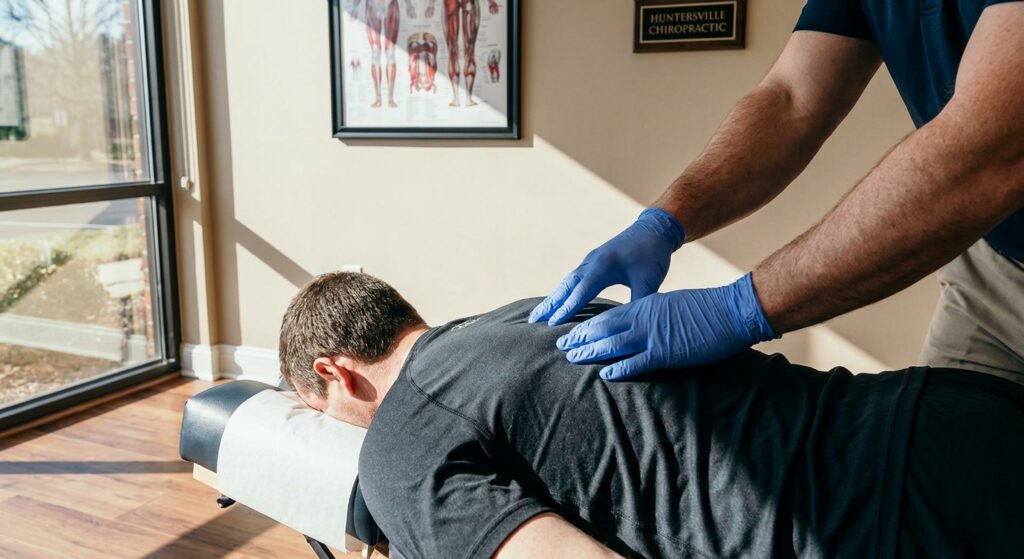
If you need x-rays, the staff takes digital images of the specific area. Dr. Doyle reviews them with you right then, pointing out the problem spots and tying them to what you feel. Then comes the exam. You lie face down, and he palpates every spinal level and every joint where you have symptoms. He checks joint movement, the muscles, and your range of motion. When your symptoms call for it, he also runs neurological testing, which means checking your reflexes, dermatomes, and myotomes. If you are nervous, he talks you through it first, only palpates with your permission, and starts gently.
This is also where the real cause sometimes surprises people. Take shoulder pain. It can come from the neck, the upper back, or the chest muscles. In someone with digestive issues, it can even be referred from the gallbladder, which is something to rule out with your medical doctor. Knowing those referral patterns lets Dr. Doyle work through the most likely culprits instead of just treating the spot that hurts.
Afterward, he sits across from you and explains which tissues are a problem, at what level, and how they connect to your symptoms. Then he lays out a few treatment options, up to about four, built around your case and your budget. He leaves out high-cost options that do not fit your situation. You can decide on the spot or go home and think it over. Either way, he walks you to the front counter himself, where the staff can schedule your next visit or start treatment that same day if you choose.
Which of the Four Tools Will You Actually Need, and When Does Each One Work Best?
Once the exam shows which tissues are involved, the next question is which tools fit. Doyle Chiropractic relies on four core tools: adjustments, Class 4 laser therapy, acupuncture and dry needling, and spinal decompression. Adjustments are the cornerstone, and they are used alone when that is appropriate. Combinations come in when a tissue may benefit from additional support.
Having all four under one roof matters. You are not waiting on a referral or driving across town for the next piece of your care. Treatments are chosen based on what you come in with and what you prefer, as long as it is safe and you are progressing. A VA evidence review on spinal manipulative therapy found manipulation was linked to modest improvement in pain and function for chronic low back pain. “Modest” is exactly why a joint-only approach sometimes may not be enough when other tissues are involved.
Adjustments: Restoring Joint Motion When the Problem Is Mechanical
An adjustment restores motion to a joint that has become restricted or locked. When the main problem is mechanical, meaning a joint is not moving the way it should, an adjustment is often the right first move. Sometimes it is the only one you need. Less is more when the exam supports it.
The reality is that a joint rarely gets restricted all by itself. The muscles around it guard, the ligaments get irritated, and sometimes the disc between the bones is involved. That is why Dr. Doyle does not treat the adjustment as the whole answer. It restores function, and then the question becomes whether the surrounding tissues need their own care.
Class 4 Laser Therapy: Supporting Repair of Damaged Tissue
Class 4 laser is one tool Doyle Chiropractic uses for tissue injury that may benefit from additional support, including injured nerves, muscles, and discs. If the exam shows tissue that is actually damaged, not just tight, laser may be part of the recommendation.
This is the piece many people skip when cost is a concern, and it is often the piece that may explain why their progress slows. An adjustment can get a joint moving, but it does not address a strained muscle or an irritated disc. Laser works on the tissue itself, and once that tissue is supported and function is back, the body can take over from there.
Acupuncture and Dry Needling: Controlling Pain and Releasing Deep Trigger Points
At Doyle Chiropractic, acupuncture is used mostly for pain and symptom management rather than tissue repair. Dry needling reaches deep trigger points and tight bands of muscle that other soft tissue work cannot. The practice uses dry needling for myofascial trigger points, chronic neck and low back pain, headaches, sciatica, sports injuries, sprains and strains, and adhesions.
Before a needle goes in, the doctor palpates the tissue and presses lightly to recreate your pain, which confirms they are on the right spot. The needle is sterile and used only once. It goes in about a quarter inch or to the center of the muscle belly. When electrical stimulation is used, the area is stimulated at 2 to 4 Hz for about 5 to 15 minutes. A session runs about 5 to 10 minutes without electricity and about 15 minutes with it.
Dr. Doyle completed North Carolina’s dry needling and acupuncture certification process, which requires a class, a minimum number of training hours, and passing a test. Doyle Chiropractic has offered dry needling for more than seven years. The practice also sets its own bar above the state’s: doctors complete the 24-hour minimum plus an extra 10 hours of practice before they ever needle a real patient.
Spinal Decompression: Creating Space When a Disc or Nerve Needs Room
Decompression creates space between the bones and can help take pressure off a bulging disc, which an adjustment cannot do. Doyle Chiropractic uses it for disc problems and arthritis, where the issue is not a stuck joint but a lack of room.
When a disc is bulging or the space between vertebrae has narrowed, the nerve running past it can get irritated. That is often where sciatica and arm pain come from. An adjustment can improve how the joint moves, but it cannot take pressure off a compressed disc. Decompression fills that gap, and pairing it with laser addresses both the space and the tissue support.
Tried a Chiropractor Before and It Did Not Last? One Patient’s Experience Shows What Can Happen When the Plan Changes
If you tried chiropractic before and the relief faded, one possible reason is that only the joints were treated and the injured tissues never got the additional support they needed. One Doyle Chiropractic patient’s experience shows exactly how that plays out and what happened when the plan changed.
This patient had spinal arthritis, including degenerative joint disease and degenerative disc disease. After the exam, Dr. Doyle recommended adjustments, decompression, laser, and cupping with manual therapy. For financial reasons, the patient chose only adjustments and cupping. That is a completely fair choice, and the practice respects it. In this one documented case, after 60 days the patient reported feeling about 20 to 30 percent better; individual results vary, and this is not a guaranteed outcome. Joint function was coming back, but the tissues were not receiving additional support, so progress hit a ceiling.
At that point Doyle Chiropractic did what it does with every plan that stalls: stopped, reevaluated, and talked honestly about the treatments that had been set aside. The patient agreed to add laser and decompression. Within 30 days the patient reported feeling 50 to 60 percent better, and within 60 days the patient reported feeling 80 to 90 percent better. Today the patient continues with about one visit a month to maintain that progress.
Here is the rule this case comes from. If you are not improving with adjustments alone after about 30 days, Doyle Chiropractic does not just keep adjusting and hope. The team reevaluates, revisits options you may have declined earlier, and may order a re-exam with imaging such as an MRI or CT. You can talk till you’re blue in the face about joint motion, but if a disc needs room and a tissue needs additional support, the plan has to account for that. As Dr. Doyle tells his patients, “I’m on your team and we’re gonna try and make things right for you,” and sometimes that means having an honest conversation at the 30-day mark.
How Is One Visit Sequenced So Your Results Hold, and When Should You Expect to Feel Better?
Choosing the right tools is half the job. The other half is the order you use them in. At Doyle Chiropractic, the treatments within a single visit are planned so everything holds better. Results typically build over about eight treatments rather than showing up all at once.
The adjustment comes before or after your other treatments depending on how your tissues look that day. If a spinal segment is acutely guarded, meaning the muscles around it are clamped down to protect it, adjusting into that guarding fights the body. So soft tissue work comes first, often cupping along the muscles beside the spine for 2 to 5 minutes. Once the area lets go, the adjustment goes in more easily and tends to hold. After that, the doctor can needle deep trigger points or cup the surface tissues as needed.
Cupping is often the first choice for soft tissue because it costs less and often gives a good overall result. Less is more when it works. Dry needling is saved for deeper tissue that cupping cannot reach, like a trigger point in the quadratus lumborum, a deep low back muscle that can mimic disc or hip pain. It is also used when a condition is not improving with cupping, adjustments, and laser.
As for timing, it depends on which tissues are involved, how long the problem has been there, and whether your plan combines treatments. A muscle strain from last week is a different case from arthritis that has been building for a decade. Think in terms of about eight visits, followed by a reevaluation. At that point, you look together at your pain level and how well you are handling your ADLs (activities of daily living) like sleeping, sitting through a workday, and getting through the grocery store. If the numbers are moving, you keep going. If they are not, the plan changes.
Why Would You Choose Doyle Chiropractic Over a Medical Pain Clinic in Huntersville?
Huntersville patients choose Doyle Chiropractic because it combines experience, honesty about cost, and every core pain management tool in one location. Dr. Geoff Doyle has been in practice for more than 20 years and has seen over 20,000 patients.
Dr. Doyle is a second-generation chiropractor and acupuncturist. He also founded a statewide North Carolina company that focuses exclusively on car accident cases, built on extensive research into the auto accident industry. That background matters for anyone with complex pain. Car accident injuries often involve several tissue types at once, symptoms that show up late, and a long recovery if the tissues are not addressed properly. If your pain started after a wreck, ask about your med pay benefits when you call, and get evaluated promptly so your injuries are documented.
Cost is the other big worry, and you deserve straight answers. Doyle Chiropractic accepts Aetna, Blue Cross Blue Shield, Medicare, and UnitedHealthcare, along with cash pay. Every plan has its own deductibles and limits, so call the office to verify your benefits and understand your out-of-pocket costs before you commit. When your treatment options are presented, they are built to fit your situation, and options that do not make sense for your case or budget stay off the table.
Then there is the one-roof difference. At many medical pain clinics, the main tools are medication and injections, which can quiet pain without setting out to address the tissue causing it. At Doyle Chiropractic, adjustments, Class 4 laser, acupuncture and dry needling, decompression, cupping, massage therapy, and a red light bed are all in the same building. Your care can be layered and sequenced in one visit instead of spread across several offices and several waiting lists. That is personalized care tailored to you, with comprehensive solutions under one roof.
What Else Do Huntersville Patients Ask Before Starting Chiropractic Pain Management?
These are the questions Doyle Chiropractic hears most often from people considering chiropractic pain management in Huntersville. Each answer reflects how the practice actually works.
How long does it take to see results from chiropractic pain management?
In Dr. Doyle’s experience, results typically build over about eight treatments. Your timeline depends on which tissues are involved, how long you have had the problem, and whether your plan combines treatments. If you are not improving after about 30 days, the plan gets reevaluated.
Will I need adjustments forever, or can I stop once the pain is gone?
No, you are not signing up for life. You and Dr. Doyle decide on your visit frequency together, based on how your tissues respond. Some patients, like the arthritis patient described above, choose one visit a month to maintain their progress. Others taper off once function is restored.
Does Doyle Chiropractic accept my insurance for pain management?
Doyle Chiropractic accepts Aetna, Blue Cross Blue Shield, Medicare, UnitedHealthcare, and cash pay. Benefits vary from plan to plan, so call the office to verify your coverage and out-of-pocket costs before your first visit.
What is the difference between chiropractic pain management and a medical pain clinic?
Chiropractic pain management finds and addresses injured tissues without drugs or injections. Medical pain clinics typically manage symptoms with medication or injections. Both have a place, and the exam will show whether you need a medical workup as well.
Can chiropractic pain management help with sciatica or nerve pain?
It may help when the nerve pain comes from a disc bulge, spinal stenosis, or a muscle spasm putting pressure on the nerve. Your plan may include adjustments to restore joint motion, decompression to create space, laser to help support tissue, and soft tissue work or dry needling to release deep muscle tension around the nerve.
What happens during my first visit for pain management at Doyle Chiropractic?
Dr. Doyle reviews your paperwork, listens to your story, and takes and reviews digital x-rays with you if needed. He then performs a hands-on exam to find which tissues are causing your pain. Afterward, he explains his findings and presents up to about four treatment options. You can choose one that day or take them home to think over.
Start With an Exam That Finds the Real Cause
Call Doyle Chiropractic in Huntersville today to schedule your first pain management evaluation. You will find out which tissues are causing your pain and which treatments are designed to address your injured tissues. If you have already tried chiropractic and your progress stalled, bring that history with you, including what was done, how often, and how far it got you. That plateau is useful information, because it tells Dr. Doyle which tissues never got the support they needed, and that is where your new game plan starts.
Ready to Find Out What’s Really Behind Your Pain?
If you’ve been managing symptoms without getting to the source, it might be time for a different approach. Doyle Chiropractic in Huntersville takes the time to understand your specific situation and create a care plan built around what your body actually needs. When you’re ready to move beyond temporary relief, give the office a call.
Individual results vary based on multiple factors including condition severity, adherence to treatment, and individual health circumstances. No specific outcome is guaranteed.