Expertise provided by Dr. Doyle, Geoffrey A Doyle
You have tried rest, over-the-counter pills, maybe even a prescription. The pain fades for a few hours, then comes right back the minute you bend over to load the dishwasher or turn your head to back out of the driveway. You start to wonder if this is just how life goes now, managing symptoms instead of fixing the problem. As a pain management chiropractor in Huntersville, Doyle Chiropractic takes a different approach. The goal is to find the exact tissue causing your pain and then work with it using adjustments, laser, acupuncture, cupping, or decompression, and never with a prescription pad.
That difference matters more than it sounds. A pill works on the pain signal. It does not know whether the signal is coming from a strained muscle, a bulging disc, an irritated nerve, or a worn-out joint, and it does not repair any of them. Tissue-targeted care starts from the other end. It asks which tissue is damaged, why it is damaged, and what that specific tissue needs.
Dr. Geoff Doyle is a second-generation chiropractor and acupuncturist. His Huntersville office, legally named Doyle Chiropractic and Acupuncture, keeps chiropractic, acupuncture, Class 4 laser, cupping, dry needling, spinal decompression, massage therapy, and a red light bed under one roof. That way your plan can include whatever your tissues may respond to. This article offers a plain-language look at how that works, how it compares to a medical pain clinic, and when it is not the right fit.
What Does Drug-Free Pain Management Actually Mean for Your Body?
Drug-free pain management means finding the specific tissue that is damaged and working with it. It is the opposite of using medication or injections to quiet the pain while the damage stays in place. At Doyle Chiropractic, every plan starts by naming the tissue, not just the symptom.
Think of your pain like a smoke alarm. Medication turns down the volume on the alarm, and sometimes that is exactly what you need to get through a rough week. The fire is still burning, though. Tissue-targeted care goes looking for the fire. Once you know whether the problem is in a muscle, a ligament, a tendon, the fascia, a disc, a nerve, or a joint, you can pick tools that work on that tissue. The reality is that two people walking in with the same or very similar low back pain can have completely different tissues driving it, so they should not get the same treatment.
Each tissue type responds to something different:
- Muscles: Tight and tender fibers and trigger points may respond to soft tissue work like cupping, massage, or dry needling.
- Ligaments and tendons: Strained or worn-down tissue often benefits from Class 4 laser.
- Discs and arthritic joints: A bulging disc or a joint narrowed by arthritis may benefit from decompression, which creates space.
- Restricted joints: A joint that is not moving the way it should may respond to an adjustment.
- Nerves: Nerves usually get irritated by a nearby muscle, disc, or joint. So the nerve symptomatology (the burning, tingling, or pain that shoots down an arm or leg) often responds once the tissue pressing on it is addressed.
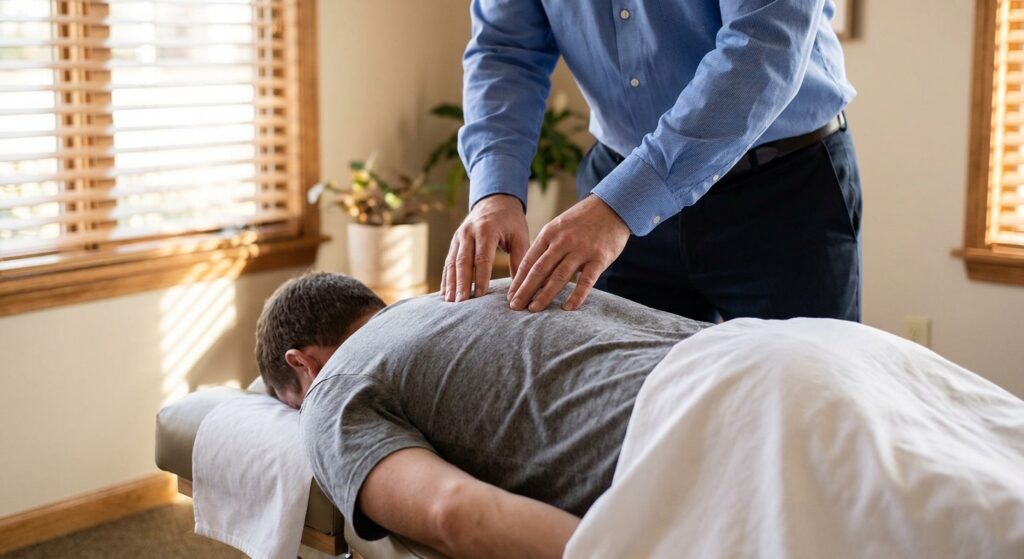
That is why the assessment matters so much. At Doyle Chiropractic, the exam includes palpation of every spinal level and every symptomatic joint, joint movement testing, a musculature assessment, range of motion, and neurological and orthopedic testing when it is called for. Neurological testing means checking reflexes, dermatomes (the skin areas each nerve supplies), and myotomes (the muscles each nerve controls). Those findings tell the doctor whether a nerve is involved and at what level. If pain runs down your leg and your reflex on that side is dull, that points toward a very different tissue than a sore spot that stays put in your low back.
Why Does One Tool Rarely Work on Damaged Tissue on Its Own?
Each tool does one job, and damaged tissue usually needs more than one job done. At Doyle Chiropractic, adjustments restore joint motion, Class 4 laser works on tissue repair, acupuncture addresses pain while that repair happens, decompression makes room for discs and arthritic joints, and cupping handles soft tissue.
Adjustments are the cornerstone. When a joint is restricted, getting it moving again takes pressure off the surrounding tissue and helps the area function the way it was designed to. For some people, that is all it takes, and less is more. If adjustments alone appear sufficient, that is what gets recommended. Often times, though, getting a joint to move and getting a worn or torn tissue to heal are two separate problems. You can have a joint that moves better after a few weeks and still feel a deep ache, because the ligament, tendon, or disc around it has not gotten what it needs.
Maybe you have been down this road before. You saw a chiropractor, felt better for a week, and then the pain crept right back, so you figured chiropractic just does not last. That is a fair worry, and it is worth saying out loud. When only the joint gets treated and the tissue underneath never gets what it needs, the pain has every reason to return. Treating the tissue, not just the joint, is how you may get results that hold up over time.
That is where tools beyond the adjustment come in. Dr. Doyle considers Class 4 laser a valuable tool for tissue repair, so it often anchors a plan when tissue damage is part of the picture. Acupuncture plays a different role. It is used more for pain and symptom control, so you can stay comfortable and keep moving while the deeper repair happens. Cupping and manual therapy go after soft tissue involvement, loosening tight fascia and muscle so the area is not guarded and pulling on everything around it.
Decompression fills a gap that adjustments cannot. It gently separates the vertebrae to create space between the bones, which may help when a disc is bulging or arthritis has narrowed the joint. A disc case often shows up as pain radiating all the way to the foot, along with a mechanism of injury that fits a disc problem, like lifting and twisting at the same time. Sometimes an MRI confirms it, but treatment often starts first, because the MRI usually does not change what the first round of care looks like.
Patients are encouraged to get adjusted before decompression. It may make the decompression more comfortable and help prevent soreness and muscle spasms afterward. The decompression table itself is gentle and smooth, and before bringing one into the Huntersville office, Dr. Doyle spent months studying one in his brother’s practice to make sure it was worth offering.
So for someone with degenerative joint and disc disease, a typical recommendation might pair adjustments with decompression, laser, and cupping, because each tool covers a different tissue. Techniques are chosen based on your presentation and your preference, as long as it is safe and you are improving. Get each tissue what it needs, and the body may do the rest.
What If Your Muscle Pain Lives Too Deep for Cupping to Reach?
Deep muscle pain that cupping cannot reach is the job dry needling was added to do at Doyle Chiropractic. Dry needling places a thin, sterile needle directly into a deep trigger point in the muscle, reaching tissue that cupping, massage, and adjustments cannot get to from the surface.
Doyle Chiropractic uses dry needling for myofascial trigger points, chronic neck pain, chronic low back pain, headaches, sciatica, sports injuries, sprain and strain injuries, and adhesions. It is not the first thing they reach for. Cupping usually comes first, because it costs less and often gives a good overall result. Dry needling comes in when the problem sits deeper, like a stubborn trigger point buried in the quadratus lumborum (a deep low back muscle that often drives one-sided back pain). It also comes in when cupping, adjustments, and laser are not giving you the improvement you need.
Here is what a session looks like. The doctor always palpates the tissue first to know exactly where the needle is going, pressing just enough to recreate your pain and confirm the right spot. Then a sterile, single-use acupuncture needle or a dedicated dry needling needle goes in to reach the trigger point in the muscle belly. It can be done with or without electrical stimulation. When stim is used, it runs at 2 to 4 Hz for roughly 5 to 15 minutes per area. Without electricity, a session usually runs 5 to 10 minutes, and with it, almost always 15.
Order matters, too. If a spinal segment is acutely guarded, soft tissue work goes first so the area relaxes. Then comes the adjustment. After that, the doctor either needles the deep trigger points or cups the more superficial tissue. Dry needling is not usually a one-visit fix. Results can build over multiple treatments, with responses varying by person.
Training is a real question here, and it should be. As Dr. Doyle explains it, North Carolina requires a certification class, a minimum number of training hours, and a passing test before a provider can perform dry needling. Doyle Chiropractic has offered dry needling for more than 7 years, and its doctors complete the 24-hour minimum plus an extra 10 hours of practice before ever treating a real patient.
Should You See a Pain Management Chiropractor in Huntersville or a Medical Pain Clinic?
See a pain management chiropractor when your pain comes from musculoskeletal tissue (muscles, joints, discs, ligaments, or nerves irritated by those structures) and you want to address it without opioids or injections. See a medical pain clinic or your physician when the cause may be a fracture, infection, tumor, or serious neurological problem that could need medication, injections, or surgery.
A medical pain clinic works mostly with prescription medications, injections, nerve procedures, and referrals to surgeons. Those tools have a real place, especially for severe or complex conditions. Tissue-targeted chiropractic care works on a different principle: find the damaged tissue and work with it using hands-on and in-office tools.
Research supports non-drug approaches for common problems. The American Chiropractic Association’s research summary points to clinical guidelines that recommend spinal manipulation among non-drug options for low back pain. A review highlighted by the NIH’s National Center for Complementary and Integrative Health found evidence that approaches including acupuncture and spinal manipulation may help some people manage back pain.
| Drug-free tissue-targeted care | Medical pain clinic | |
|---|---|---|
| Main goal | Work with the damaged tissue | Control pain signals and inflammation |
| Common tools | Adjustments, laser, acupuncture, decompression, cupping, dry needling | Medications, injections, nerve procedures, surgical referral |
| Best fit | Musculoskeletal pain with identifiable tissue involvement | Fracture, infection, tumor, severe neurological deficit |
| Uses opioids or injections | No | Sometimes |
Chiropractic is the wrong first stop if you have any of the warning signs below. See a physician or go to the nearest emergency room or medical center right away if you notice:
- Loss of bladder or bowel control, or numbness in the groin
- Leg or arm weakness that is getting worse
- Back pain with fever, or after a serious fall or crash
- Unexplained weight loss or a history of cancer
Part of the first-visit screening at Doyle Chiropractic is looking for exactly these red flags. If something points away from musculoskeletal tissue, you get pointed toward the right medical care. Also, never stop a prescribed medication without talking to the doctor who prescribed it. Drug-free care can work alongside your physician, not against them.
Where Doyle Chiropractic fits best is the wide middle ground: pain too stubborn for rest and a bottle of ibuprofen, but not a surgical case. Many people in that spot end up bouncing between a chiropractor, an acupuncturist, and a physical therapist at three different offices. Keeping every tool under one roof, at one location, means your plan can change in the same building, on the same day, when your tissues need something different.
What Happens at Your First Visit, and How Soon Should You Expect Change?
Your first visit to Doyle Chiropractic is a conversation, an exam, and a clear explanation of which tissues may be causing your pain, followed by a few treatment options you can choose from with no pressure. Some people notice changes within the first few weeks, with results building over repeated visits and checked at each re-exam, though the response time varies by individual and by the tissue involved.
It starts simply. Dr. Doyle knocks, introduces himself, shakes your hand, and asks you to tell your story. You walk through what bothers you most, and he breaks each symptom down one at a time, because your headache and your mid-back ache may not share the same cause. If x-rays are needed, they are taken digitally and reviewed with you right there. Then comes the face-down exam: palpation of every spinal level and symptomatic joint, joint movement, musculature, range of motion, and neurological and orthopedic testing when needed.
After that, he sits across from you and lays out the game plan. He ties each symptom to the tissue behind it so the whole thing tells a clear story you can actually follow. If something does not make sense, ask, because he will talk till he is blue in the face to make sure you understand what is going on and why. Then he presents a couple of options, up to about four, and rules out anything that is less likely to work or costs more than it is worth for your situation. As he tells his patients, “I’m on your team and we’re gonna try and make things right for you.”
You can decide on the spot or go home and think about it. Either way, he personally walks you to the front counter, where the staff schedules your next visit or your treatments. Doyle Chiropractic accepts Aetna, Blue Cross Blue Shield, Medicare, and UnitedHealthcare, along with cash pay. The front desk can walk you through what your out-of-pocket costs may look like before you commit, so there are no surprises when your EOBs show up.
Timelines depend on the tissue and the person. Muscle and joint problems often respond sooner in some patients. Deep trigger point work may build over multiple dry needling treatments. Discs and degenerative joints can take longer. Along the way, your plan gets reevaluated with a re-exam, usually somewhere in the 30 to 60 day range. That re-exam checks your pain score, your function, and how well you are handling everyday activities like sleeping, sitting at work, and picking up your kids. For example, if you are improving at your 30-day re-exam, the plan may start to taper. If you are stuck, the plan changes. That is the point of tracking it.
The experience behind this matters on complex cases. Dr. Doyle has more than 22 years of experience treating car accident injuries and founded a statewide North Carolina company that focuses only on car accident cases. Those cases tend to involve several injured tissues at once, which is exactly the kind of puzzle a tissue-by-tissue approach is built for.
What Else Do Huntersville Patients Ask About Drug-Free Pain Management?
Most questions come down to four things: whether this counts as real pain management, what it treats, when it is the wrong choice, and how long it takes. Here are straight answers.
Is chiropractic considered pain management?
Yes. Chiropractic is a form of pain management, but it targets the damaged tissue causing the pain rather than masking symptoms with medication or injections. At Doyle Chiropractic, that means combining adjustments with tools like laser, acupuncture, and decompression based on what your exam finds.
What conditions may drug-free pain management help in Huntersville?
It is commonly used for back pain, neck pain, sciatica, headaches, sports injuries, disc bulges, arthritis, sprains and strains, and myofascial trigger points, when musculoskeletal tissue damage is the underlying cause. Results vary from person to person, and the exam determines whether you may be a good fit.
When is chiropractic care NOT appropriate for my pain?
Chiropractic is not appropriate for a fracture, infection, tumor, or severe neurological problem that may need surgery. Warning signs like loss of bladder control, worsening weakness, or back pain with fever need immediate medical attention.
How do I choose between a pain management chiropractor in Huntersville and a medical pain clinic?
Choose a pain management chiropractor when tissue involvement in muscles, joints, discs, or ligaments is the cause and you want to avoid opioids or injections. Choose a medical pain clinic for fractures, infections, or severe neurological problems that need medication or surgery.
Should I see a chiropractor or a massage therapist for nerve pain?
Nerve pain usually comes from something pressing on the nerve, like a bulging disc or a restricted joint. Massage may help tight muscle, but if a disc is the cause, you likely need adjustments or decompression too. Doyle Chiropractic offers massage therapy alongside chiropractic care, so you do not have to guess.
How long does drug-free pain management take to work?
Some people notice early changes within weeks. Deep muscle work through dry needling may build over multiple treatments. Response varies by person, by tissue, and by condition. Plans are reevaluated with a re-exam, often every 30 to 60 days, and adjusted as your tissues respond.
What makes Doyle Chiropractic different from other chiropractors in Huntersville?
Doyle Chiropractic offers chiropractic, acupuncture, Class 4 laser, cupping, dry needling, spinal decompression, massage, and a red light bed under one roof, so you are not coordinating care between several offices. Every plan is personalized to the specific tissues causing your pain, and you always get options without pressure.
Your Next Step: Bring Three Notes to Your First Visit
Before your first visit, take two minutes and write down three things: the one movement that hurts most, exactly where the pain travels (does it stop at your hip, or run past your knee toward your foot), and everything you have already tried. Where your pain travels is one of the fastest clues to which tissue is involved, and walking in with those notes gets you to the right plan sooner. Call Doyle Chiropractic in Huntersville today to schedule your first-visit tissue assessment and find out which combination of adjustments, laser, acupuncture, or decompression may fit the exact tissues involved in your pain.
Ready to Address Pain at Its Source?
If you live in or near Huntersville, or elsewhere in the Charlotte area, and you’ve been managing discomfort with medication but want a different approach, the team at Doyle Chiropractic in Huntersville is here to help. We focus on identifying what’s actually causing your pain and creating a care plan that supports your body’s natural healing. Reach out today to discuss how tissue-targeted treatment might work for you.
Individual outcomes vary; there is no guarantee of specific results, and what works for one patient may not work for another.