Key Takeaways
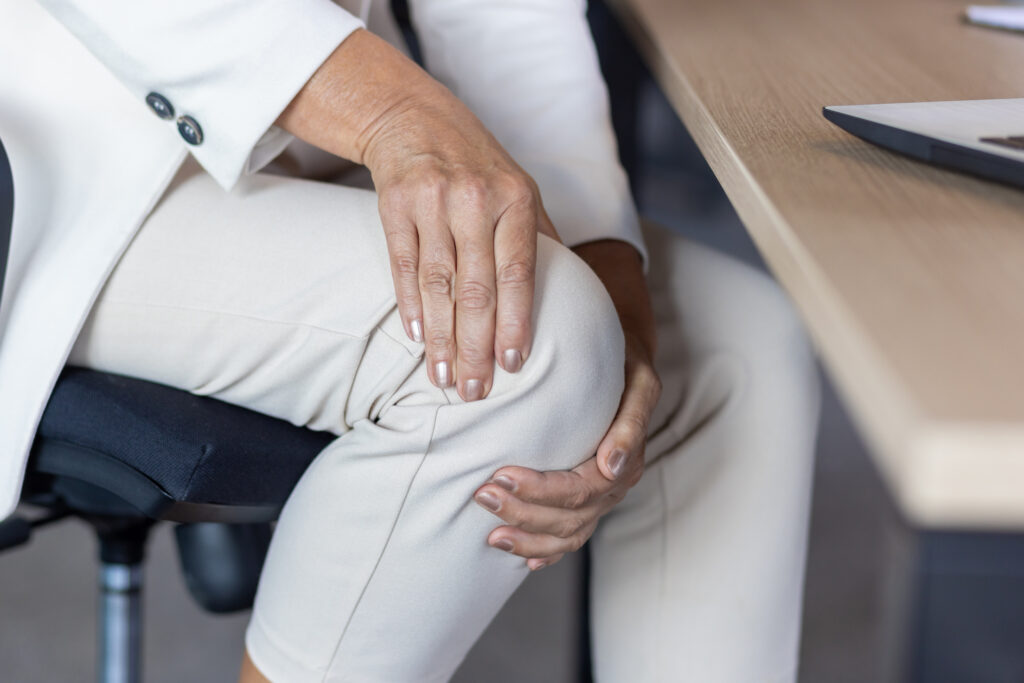
- Knee pain after prolonged sitting is a common symptom pattern, not a diagnosis. Patellofemoral pain, arthritis, joint stiffness, previous injury, and other knee conditions can all make the transition from sitting to standing uncomfortable.
- Pain around or behind the kneecap is especially common after sitting with the knee bent. The patellofemoral joint remains loaded in a flexed position, which can aggravate an already sensitive knee.
- Pain that improves after the first several steps often reflects a different pattern from a knee that becomes progressively more painful the farther you walk. How symptoms change after standing provides useful diagnostic information.
- Weakness and reduced physical capacity can matter even when nothing is structurally “out of place.” Hip, thigh, and lower-extremity strength help the knee tolerate sitting, standing, stairs, squatting, and walking.
- Persistent swelling, locking, giving way, inability to bear weight, significant trauma, or a hot and markedly swollen knee deserves evaluation rather than simply being blamed on sitting too long.
The First Few Steps After Sitting Can Tell Us a Lot
A patient may sit through:
- A movie
- A long meeting
- Dinner
- A flight
- A car ride
- Several hours at a desk
and feel reasonably comfortable.
Then they stand.
The knee feels stiff.
The first few steps hurt.
Sometimes the patient has to straighten the leg several times before walking normally.
After moving around for a minute or two, the knee may loosen and feel substantially better.
This pattern is common enough that many people assume it is simply part of getting older.
Age can influence what is happening inside the knee, but the symptom itself deserves a more useful explanation.
The important question is:
Why does the transition from prolonged sitting to movement provoke the knee?
Sitting Changes the Mechanical Environment of the Knee
When you sit in a chair, the knee remains bent.
That position changes how different structures within the joint interact.
The kneecap—or patella—sits at the front of the knee and moves within a groove at the end of the femur.
Together, these surfaces form the patellofemoral joint.
As the knee bends, contact between the patella and femur changes.
For a healthy, comfortable knee, sitting is usually uneventful.
But when the patellofemoral region is already sensitive, remaining in a flexed position for a long period can become uncomfortable.
This is one reason patients with anterior knee pain often describe difficulty after prolonged sitting.
The “Movie Theater Sign”
Historically, clinicians have sometimes referred to anterior knee discomfort after prolonged sitting as the movie theater sign.
The patient sits with the knees bent through a movie.
When it is time to stand, the front of the knee aches.
The term is descriptive rather than diagnostic.
It can occur in people with patellofemoral pain, but the symptom by itself does not prove that diagnosis.
Still, it provides useful information.
When the same patient also reports pain with:
- Stairs
- Squatting
- Lunges
- Running
- Getting up from a low chair
the overall pattern begins to point more strongly toward the patellofemoral region.
Patellofemoral Pain Is More Than a “Bad Kneecap”
Patients are sometimes told that their kneecap is simply tracking incorrectly.
That explanation can be too simplistic.
Patellofemoral pain is influenced by the interaction of:
- Joint loading
- Activity volume
- Lower-extremity strength
- Movement strategy
- Tissue sensitivity
- Previous injury
- Individual anatomy
The kneecap does not need to be dramatically “out of place” for the area to become painful.
Often, the more useful model is one of load and capacity.
How much stress is the knee currently experiencing?
How much can it comfortably tolerate?
And has something recently changed that shifted that balance?
Sitting May Expose the Problem Without Being the Original Cause
A patient may say:
“Sitting is what hurts my knee.”
But sitting may simply be the activity that reveals an already irritated joint.
Consider someone who recently began:
- Running
- Squatting more heavily
- Playing pickleball
- Hiking
- Climbing more stairs
- Increasing workout frequency
The knee becomes irritated from the overall increase in load.
Then the patient notices pain after sitting.
The chair did not necessarily create the entire problem.
It may be where the irritated knee becomes most noticeable.
That distinction matters because changing chairs alone will not necessarily restore the knee’s capacity.
Arthritis Creates a Different Version of the Same Complaint
Knee osteoarthritis can also produce stiffness after inactivity.
A patient may describe:
“Once I get moving, I’m okay. It’s getting started that’s the problem.”
They may notice stiffness after:
- Sitting
- Driving
- Sleeping
- Resting after activity
The first several steps can be uncomfortable.
Then the knee begins moving more freely.
This is sometimes called gelling—a feeling of stiffness that develops after the joint has remained relatively still.
The presence of this pattern does not automatically mean severe arthritis.
And the intensity of symptoms does not always correspond perfectly to what an X-ray shows.
Clinical findings and function still matter.
Arthritis on an X-Ray Does Not Tell the Entire Story
Degenerative changes become increasingly common with age.
An X-ray may show:
- Joint-space narrowing
- Osteophytes or bone spurs
- Other osteoarthritic changes
Those findings can be relevant.
But imaging should be interpreted alongside the patient’s actual symptoms.
Two people can have similar-looking X-rays and very different levels of function.
One may walk several miles without difficulty.
The other may struggle to get out of a chair.
The goal is not simply to tell a patient:
“You have arthritis.”
It is to determine how much the joint changes appear to matter clinically and what modifiable factors can improve function.
The Location of the Pain Helps Separate Different Knee Problems
When a patient reports pain after sitting, we want to know exactly where it occurs.
Front of the Knee
Pain around or behind the kneecap may fit a patellofemoral pattern.
Inside or Outside the Knee
Joint-line pain can raise questions about structures such as the meniscus or the tibiofemoral joint.
Back of the Knee
Posterior knee discomfort has a different differential diagnosis and may involve joint, tendon, cystic, or other structures.
Diffuse Stiffness Throughout the Joint
This can occur with arthritis, inflammation, or other intra-articular problems.
A patient saying:
“My knee hurts.”
is the beginning of the history, not the end of it.
Why Getting Out of a Low Chair Can Hurt More
Standing from a chair requires the knee and hip muscles to generate force.
A lower seat generally requires:
- Greater knee bending
- Greater hip bending
- More muscular effort to rise
That is why some patients can get out of a tall chair reasonably well but struggle with:
- Low couches
- Deep restaurant booths
- Low car seats
- Toilets
- Theater seats
This is not merely a flexibility issue.
It can reveal reduced lower-extremity strength or a knee that currently has limited tolerance for deeper flexion under load.
The Quadriceps Matter
The quadriceps muscles on the front of the thigh play a major role in knee function.
They help:
- Straighten the knee
- Control lowering into a chair
- Rise from sitting
- Climb stairs
- Absorb load during walking
When quadriceps strength or endurance is reduced, ordinary activities can become relatively more demanding.
This can happen after:
- Injury
- Surgery
- Pain-related inactivity
- Prolonged deconditioning
- Reduced exercise
The knee does not necessarily need more rest.
In many cases, it needs a carefully graded return to greater capacity.
Hip Strength Can Influence Knee Loading
The hip also contributes to lower-extremity control.
Hip muscles help manage the position of the pelvis and thigh during:
- Walking
- Stairs
- Squatting
- Running
- Standing from a chair
For some patients with knee pain, improving hip strength can be a useful part of rehabilitation.
That does not mean every knee problem originates from “weak hips.”
The hip should be assessed as part of the movement system rather than blamed automatically.
The treatment plan should follow the findings.
Why the Knee Sometimes Pops When You Stand Up
Some patients notice:
“Every time I get up, my knee cracks.”
Knees commonly make noise.
Popping, clicking, or grinding—sometimes called crepitus—can occur for several reasons and is not automatically a sign of damage.
The more important questions are whether the noise is associated with:
- Pain
- Swelling
- Locking
- Giving way
- Loss of motion
A painless pop is very different from a knee that catches painfully and cannot fully straighten.
Sound alone is not a diagnosis.
Stiffness Is Not Always the Same as Loss of Motion
Patients use the word stiff in different ways.
One person means:
“It feels tight for the first five steps.”
Another means:
“I physically cannot straighten my knee all the way.”
Those are different clinical findings.
A sensation of stiffness can occur without a major measurable restriction.
A true loss of knee extension or flexion may indicate:
- Joint swelling
- Arthritis
- Mechanical restriction
- Injury
- Other structural problems
That difference becomes clear during examination.
Swelling Changes How the Knee Functions
A swollen knee often feels:
- Tight
- Heavy
- Stiff
- Difficult to bend
- Difficult to fully straighten
Even relatively modest joint swelling can affect muscle function and movement.
The patient may notice that sitting with the knee bent becomes uncomfortable because the joint feels pressurized.
When swelling is present, we want to understand why.
Possibilities include:
- Overload
- Arthritis
- Injury
- Meniscal or other internal joint irritation
- Inflammatory conditions
- Other medical causes
Persistent or recurrent swelling deserves more attention than simple postural stiffness.
Meniscal Problems Can Produce Sitting-to-Standing Symptoms Too
The menisci are fibrocartilage structures within the knee that help distribute load and contribute to joint function.
Meniscal problems can produce symptoms such as:
- Joint-line pain
- Swelling
- Pain with twisting
- Catching
- Difficulty with deep bending
Some patients notice symptoms when rising after the knee has been bent for a prolonged period.
But not every MRI finding labeled a meniscal tear is automatically the source of pain.
Degenerative meniscal changes are common, particularly as people age.
Clinical correlation matters.
The question is whether the history, examination, and imaging—when needed—tell the same story.
True Locking Is Different From a Knee That Feels Stiff
A patient may say:
“My knee locks up when I stand.”
We need to clarify what “locks” means.
Sometimes the patient simply means the knee feels stiff for several steps.
True mechanical locking is different.
The knee may physically become stuck and temporarily be unable to fully bend or straighten.
That finding deserves evaluation because it can suggest a mechanical problem within the joint.
The patient’s choice of words is important, but we still need to define exactly what they are experiencing.
Why a Long Car Ride Can Be Particularly Uncomfortable
Driving combines several factors:
- The knee remains bent
- Movement is limited
- The seat may place the hip and knee in a relatively fixed position
- The right leg repeatedly operates the pedals
- Getting out of the vehicle requires an immediate transition from sitting to weight-bearing
A patient may feel relatively comfortable during the drive but struggle during the first several steps afterward.
That pattern can occur with both patellofemoral and arthritic knee conditions.
On longer trips, periodic opportunities to get out and move may improve comfort for some patients.
Should You Straighten the Knee While Sitting?
Changing knee position periodically can be useful if prolonged flexion aggravates symptoms.
For example, during a long desk session or flight, a patient may feel better occasionally:
- Straightening the leg
- Moving the knee through a comfortable range
- Standing
- Walking briefly
This is different from believing that bending the knee is damaging it.
The knee is designed to bend.
The issue is that an already sensitive joint may tolerate movement variety better than one sustained position.
Rest Is Not Always the Long-Term Answer
When the knee hurts, reducing a clearly aggravating activity for a short period can be appropriate.
But excessive avoidance can create another problem.
The quadriceps and other lower-extremity muscles may become less conditioned.
Then:
- Stairs become harder
- Getting out of chairs becomes harder
- Walking becomes more demanding
- The knee’s capacity decreases further
For many mechanical knee conditions, the goal is therefore not permanent avoidance.
It is to find an appropriate level of activity and progressively rebuild from there.
What the Symptom Does After You Stand Is Important
The first several minutes after sitting can help us understand the pattern.
Pain That Quickly Improves With Movement
This may fit stiffness associated with inactivity, including certain arthritic presentations.
Pain That Continues or Progressively Worsens With Walking
This raises different questions about joint loading, tendon involvement, injury, or other mechanical problems.
Pain With Catching or Locking
This deserves evaluation for internal mechanical problems.
Pain With Significant Swelling
We need to determine why the joint is swollen.
Pain With Giving Way or True Weakness
Stability and neurological function may need closer assessment.
The phrase “it hurts after sitting” becomes much more useful once we know what happens next.
When Knee Pain After Sitting Should Be Evaluated
Occasional mild stiffness that disappears quickly may not indicate a significant problem.
Evaluation becomes more appropriate when:
- Symptoms persist for weeks
- Pain is becoming more frequent
- The knee repeatedly swells
- Walking tolerance is declining
- Stairs become difficult
- The patient struggles to rise from chairs
- The knee catches or locks
- The knee repeatedly gives way
- Motion is noticeably restricted
- There was a significant injury
- Pain begins interfering with normal exercise or daily activities
The objective is not simply to make the knee feel better for the first five steps after standing.
It is to understand why the knee has become sensitive to sitting and whether its mobility, strength, joint health, or overall load tolerance needs to be addressed.
How Doyle Chiropractic Evaluates Knee Pain After Sitting
The evaluation begins by determining what the patient actually means by:
“My knee hurts when I get up.”
We want to know:
- Where is the pain?
- How long was the patient sitting?
- Does the knee hurt while sitting or only when standing?
- How many steps does it take to loosen up?
- Does walking make it better or worse?
- Is there swelling?
- Does the knee catch, lock, pop, or give way?
- Are stairs or squatting painful?
- Was there a previous injury?
- Has activity recently increased or decreased?
Dr. Geoffrey Doyle may then assess:
- Knee range of motion
- Patellar and knee-joint function
- Quadriceps strength
- Hip and lower-extremity strength
- Functional movements
- Walking mechanics
- Joint-line tenderness
- Swelling
- Orthopedic testing
- Neurological function when indicated
We may also observe activities that reproduce the actual complaint, such as:
- Sitting to standing
- Squatting
- Stepping up
- Stepping down
- Walking
The objective is to determine which part of the movement is difficult and why.
Treatment Should Address More Than the First Painful Step
For appropriately selected musculoskeletal knee conditions, conservative treatment may include:
- Therapeutic exercise
- Progressive strengthening
- Mobility work when indicated
- Activity modification
- Chiropractic or manual treatment for clinically relevant joint restrictions
- Soft tissue therapy
- Class IV laser therapy when appropriate
- Gradual return to normal activity
The proportions depend on the diagnosis.
A patient with patellofemoral pain may need a different exercise progression from someone with significant knee osteoarthritis.
A patient with true mechanical locking needs a different evaluation from someone whose knee simply feels stiff after a long movie.
Treatment should follow the clinical pattern rather than the symptom label.
Strengthening the Knee Without Overwhelming It
Strengthening is often important, but the starting point matters.
If getting out of a low chair is already significantly painful, repeatedly performing deep squats may not be the best first exercise.
Rehabilitation can begin at a tolerable level and progress.
Depending on the patient, exercises may include:
- Sit-to-stand practice from a higher surface
- Quadriceps strengthening
- Step exercises
- Hip strengthening
- Controlled squatting
- Leg-press variations
- Balance and functional training
As capacity improves, the exercises can become progressively more demanding.
This is the same principle we use throughout musculoskeletal rehabilitation:
Load enough to create adaptation without repeatedly exceeding what the tissue can currently tolerate.
Sit-to-Stand Can Become Both an Exercise and an Outcome Measure
The activity that hurts can sometimes become one of the most useful ways to measure recovery.
Suppose a patient initially needs both hands to push out of a chair because the knee hurts.
Over time, they progress to:
- Standing with light hand assistance
- Standing without using the hands
- Rising comfortably from a standard chair
- Rising from a lower chair
- Repeating the movement without meaningful pain
That progression tells us something practical.
The patient is not simply reporting a lower pain score.
They are regaining a normal daily function.
Why Quadriceps Strength Is So Important
The quadriceps help manage forces through the knee during many of the activities that provoke symptoms.
These include:
- Standing from a chair
- Sitting down
- Stairs
- Squatting
- Walking downhill
Pain can sometimes create a cycle.
Knee hurts → patient uses the leg less → quadriceps become less conditioned → ordinary activities become relatively harder → knee remains sensitive to load.
Breaking that cycle often requires progressive use rather than indefinite avoidance.
The exact exercise dosage depends on the patient’s diagnosis, age, baseline capacity, and symptom response.
Hip Strengthening Can Be Part of the Plan
Hip strengthening may also be incorporated, particularly when examination identifies deficits in lower-extremity control or capacity.
Exercises may target:
- Hip abductors
- Hip extensors
- Other muscles contributing to lower-extremity function
For some patients with patellofemoral pain, combining hip and knee strengthening can be useful.
But the treatment should remain individualized.
The goal is not to tell every patient that their knee hurts because their glutes are weak.
It is to identify which deficits are actually present and address them.
Mobility Work Should Be Based on Measured Restriction
Some painful knees genuinely lose motion.
The patient may struggle to:
- Fully straighten the knee
- Bend it comfortably
- Move after prolonged sitting
When a meaningful restriction is present, treatment may include appropriate mobility work.
That can involve:
- Range-of-motion exercises
- Joint mobilization
- Stretching of relevant surrounding tissues
- Functional movement
But more mobility is not always better.
A patient whose knee already moves normally but becomes painful under load may need capacity more than flexibility.
The examination should make that distinction.
Chiropractic and Manual Treatment
Chiropractic or manual care may be incorporated when clinically relevant restrictions are identified in the knee or related regions.
Depending on the patient, treatment may address:
- Knee-joint mechanics
- Patellar mobility
- Ankle restrictions
- Hip restrictions
- Other lower-extremity mechanical findings
The goal is not to suggest that the knee repeatedly moves “out of place” while the patient is sitting.
Manual treatment may improve motion and comfort when an appropriate restriction exists.
For many patients, it works best alongside exercise and progressive restoration of function rather than as a stand-alone strategy.
Soft Tissue Therapy
Soft tissue treatment may be useful when there is relevant muscular tenderness, guarding, or restriction around the knee and thigh.
Potential targets depend on the examination and may include structures around the:
- Quadriceps
- Hamstrings
- Calf
- Other surrounding soft tissues
Soft tissue care may improve comfort and help the patient move more easily.
But if reduced strength or load tolerance is a major part of the problem, passive treatment alone will not fully restore that capacity.
Class IV Laser Therapy
Class IV laser therapy may be incorporated into care for selected musculoskeletal knee conditions when clinically appropriate.
Laser therapy delivers therapeutic light energy to targeted tissues to support normal healing processes and may be used as an adjunct for pain and inflammation management.
Depending on the diagnosis, it may be combined with:
- Therapeutic exercise
- Activity modification
- Manual care
- Soft tissue therapy
Laser therapy does not reverse every structural change seen on an X-ray, nor should it be presented as a replacement for appropriate orthopedic evaluation when significant structural pathology is suspected.
The treatment objective remains improved function.
The Dr. Doyle Perspective
“When somebody tells me their knee hurts after they sit, I want to know what happens during those first few steps. Does it loosen up almost immediately? Does it keep getting worse the farther they walk? Is the pain behind the kneecap? Is the knee swollen or actually locking? Those details help separate a knee that is stiff and needs better movement and capacity from one where we need to investigate something more significant inside the joint.”
— Dr. Geoffrey Doyle, DC
Our Clinical Experience
One of the most common versions of this complaint comes from a patient who has gradually become less active.
The knee starts hurting.
So the patient avoids:
- Squatting
- Stairs
- Exercise
- Longer walks
For a while, that feels like the logical thing to do.
But months later, getting out of a chair has become even harder.
At that point, part of the problem may be the knee condition itself, while another part is the loss of strength and capacity that developed around it.
The solution is not to force the patient through painful exercise.
It is to find an appropriate starting point and gradually rebuild what has been lost.
That distinction—between protecting an irritated knee temporarily and permanently avoiding normal knee loading—can be very important.
Measuring Recovery Through Everyday Function
For this type of knee complaint, we can track activities patients perform every day.
Can they:
- Sit through a meal comfortably?
- Get out of the car normally?
- Stand from a chair without using their hands?
- Walk normally on the first few steps?
- Climb stairs?
- Sit through a movie?
- Travel without significant stiffness?
- Return to exercise?
Suppose a patient initially needs several minutes before the knee loosens after sitting.
Later, they stand and walk normally almost immediately.
That is a meaningful functional improvement.
When X-Rays Are Useful
X-rays may be appropriate when the history and examination raise concern for:
- Osteoarthritis
- Significant degenerative changes
- Previous trauma
- Fracture
- Other bony or structural abnormalities
Weight-bearing knee X-rays can provide useful information about joint-space changes and arthritis.
But imaging findings need clinical context.
Finding arthritis does not automatically explain every symptom.
The patient’s:
- Pain location
- Mobility
- Strength
- Swelling
- Functional limitations
still matter.
When MRI Is Appropriate
MRI provides information about soft tissues and internal knee structures that are not shown well on ordinary X-rays.
It may be considered when there is concern for:
- Meniscal injury
- Ligament injury
- Cartilage injury
- Other internal joint pathology
- Persistent unexplained symptoms
MRI is particularly useful when the result is likely to change management.
It should not automatically be ordered simply because knee pain has lasted a certain number of days.
And an MRI finding should not be interpreted independently from the patient’s symptoms and examination.
When Orthopedic Referral Is Appropriate
Orthopedic or sports-medicine evaluation may be appropriate when there is:
- True mechanical locking
- Significant instability
- Major traumatic injury
- Persistent substantial swelling
- Suspected significant ligament or meniscal injury
- Advanced arthritis with major functional limitation
- Failure to improve appropriately with conservative care
- A condition potentially requiring injection, procedural treatment, or surgery
Conservative care and orthopedic care are not opposing approaches.
The correct pathway depends on what the knee needs.
When a Swollen Knee Needs More Attention
A mildly irritated knee after unusual activity is different from a knee that becomes:
- Rapidly swollen
- Very warm
- Red
- Extremely painful
A hot, markedly swollen joint—particularly when accompanied by fever or systemic illness—requires prompt medical evaluation.
Likewise, substantial swelling immediately following trauma may indicate significant internal injury.
Those presentations should not simply be treated as ordinary stiffness after sitting.
When Knee Pain Needs Prompt Medical Evaluation
Prompt evaluation is appropriate when knee symptoms include:
- Inability to bear weight
- Significant traumatic injury
- Visible deformity
- Rapid or substantial swelling
- A red, hot joint
- Fever or systemic illness
- True locking
- Repeated significant giving way
- Progressive weakness or neurological symptoms
- Severe unexplained pain
The majority of knee stiffness after sitting does not represent an emergency.
But recognizing when the pattern no longer looks like routine mechanical knee pain is an important part of safe care.
Frequently Asked Questions
Why does my knee hurt when I stand after sitting?
Several conditions can cause this pattern. Patellofemoral pain, knee osteoarthritis, joint stiffness, weakness, and previous knee injuries are among the possibilities. Pain location and what happens during the first several steps help narrow the cause.
Why does my knee loosen up after I walk for a few minutes?
Some joint conditions produce stiffness after inactivity that improves once the knee begins moving. This is common in certain arthritic presentations, although the symptom alone does not establish a diagnosis.
Why does the front of my knee hurt after sitting?
Pain around or behind the kneecap after prolonged sitting can occur with patellofemoral pain. Symptoms may also occur during stairs, squatting, or getting out of a low chair.
Does knee pain after sitting mean I have arthritis?
No. Arthritis is one possibility, but younger patients and people without significant arthritis can also experience this pattern. An examination can help identify the likely source.
Should I keep my knee straight while sitting?
You do not need to avoid bending the knee entirely. If prolonged flexion aggravates symptoms, periodically changing position, straightening the leg, standing, and walking may improve comfort.
Should I exercise a knee that hurts?
For many musculoskeletal knee conditions, appropriately dosed exercise is beneficial. The type and intensity should match the diagnosis and current capacity. Significant injury, substantial swelling, or other concerning findings may require evaluation before progressing exercise.
Can chiropractic care help knee pain?
For appropriately selected musculoskeletal knee conditions, chiropractic or manual care may help address clinically relevant joint restrictions. Treatment may also include therapeutic exercise, mobility work, soft tissue therapy, activity modification, and Class IV laser therapy depending on the diagnosis.
When should I get an MRI for knee pain?
MRI may be appropriate when the history and examination suggest significant internal joint pathology or when persistent symptoms remain unexplained and imaging would change management. Not every episode of knee pain requires MRI.