Expertise provided by Dr. Doyle, Geoffrey A Doyle
If your picture of a chiropractor comes from a rough, twisting neck crack in a TikTok clip, it makes sense to worry that your back is next. Dr. Geoff Doyle hears that worry all the time, and he says it’s the biggest misconception people bring to their first visit. A visit to a spinal care Huntersville chiropractor at Doyle Chiropractic looks very different from those clips, and once on the table, many patients say they’re surprised by how slow, smooth, and comfortable the experience feels.
You’re probably reading this because your back or neck has bothered you for a while. You’d like relief, and you’d rather not be hurt, rushed, or talked into something along the way. That’s a fair thing to want. So here is a plain picture of what happens at Doyle Chiropractic in Huntersville, NC: the table, the pressure, the sound, how the feel changes from one person to the next, and what comes after the adjustment.
What is a chiropractic adjustment, and what does it actually feel like?
A chiropractic adjustment is a precise, controlled movement intended to help a restricted spinal joint move more freely. At Doyle Chiropractic, it feels like gentle hands, slow positioning, and steady pressure, finished by one quick, very small push that moves the bone just millimeters.
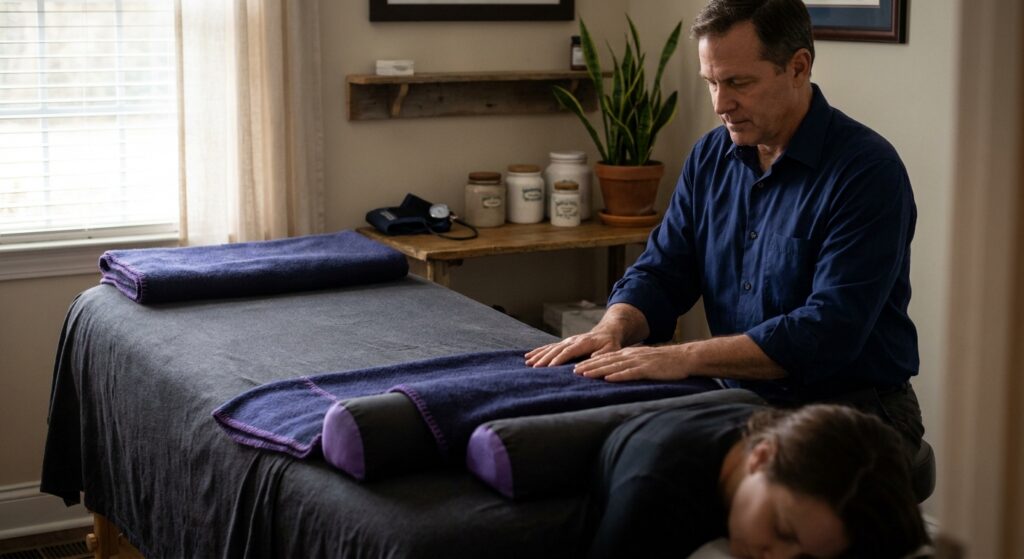
Here is the sequence most patients go through. You lie face down on a padded table, and Dr. Doyle runs his hands along your spine, feeling each level for anything that is restricted or out of position. When he finds a joint that isn’t moving well, he tests it with light pressure in different directions so he knows which way it’s restricted. Then he slowly eases you into position and finishes with a short, small, dynamic thrust. That thrust is over in a fraction of a second, and most of the visit is the slow, careful setup that comes before it.
The setup takes care because every spinal joint can move in 12 different ranges of motion, so there are many ways a joint can become restricted. Dr. Doyle’s view is that it’s important to be very specific, move slowly, and keep that final movement tiny. Think of a dresser drawer that has slipped off its track. You don’t yank it, because that bends the runners. You lift it a little, line it up, and give it one small nudge, and a careful adjustment is meant to work in a similar spirit.
Sometimes you’ll hear a pop, and sometimes you won’t. That sound is gas releasing from the fluid inside the joint, much like cracking your knuckles, and it doesn’t tell you whether the adjustment was effective. Many of the gentlest methods used at Doyle Chiropractic make no sound at all, because the goal is improved motion, not noise. The American Chiropractic Association points to a growing body of research on chiropractic care for common complaints like low back pain, neck pain, and headaches, and none of that research depends on hearing a crack.
How does the feel change from one technique to the next?
Now that you know the basic sequence, it helps to know the feel depends on which technique fits your body and condition. Doyle Chiropractic starts gentle and matches the method to you, and as long as a technique is safe for your condition, your preference gets real weight in that choice.
Acute low back pain. If your low back is fresh and irritated, Dr. Doyle usually starts with gentle prone traction adjustments. You lie face down while he applies a slow, light pull, and many people describe it as a gentle stretch. He may also use an activator, a small handheld instrument that delivers a quick, light tap to a specific spot with no twisting. As things calm down, he can add diversified adjustments, his go-to hands-on technique, and drop table adjustments, where a section of the table drops a fraction of an inch during the thrust so the table carries part of the motion and less force is needed.
Pregnancy. Pregnant patients lie face down on a tummy pillow that leaves room for the belly, so you can rest comfortably while your back is adjusted. Gentle side-lying adjustments can be used to address range of motion, and diversified work can be used for the neck and upper back.
Arthritis. Arthritic joints can be sensitive to aggressive adjusting, so the approach leans on traction and very gentle prone or seated adjustments, and the activator is often considered here.
Disc problems, or people who dislike aggressive adjustments. Cox flexion-distraction uses a table that gently bends and lengthens your lower spine in a slow, rhythmic motion, and it feels like a stretch. Dr. Doyle considers it for acute low backs, disc issues, older patients, people with arthritis, and anyone who simply doesn’t want a forceful adjustment.
One point of confusion is worth clearing up. Active Release Technique (ART) is soft tissue work on muscles and fascia, not an adjustment, so it’s never what moves a bone.
Dr. Doyle believes less is more. Many patients assume they’ll eventually be pushed into the most forceful style, but that’s not how it works here. If you’re comfortable with a gentle technique and it’s suiting you, he’ll often stay right there rather than pushing toward something more aggressive.
How does Dr. Doyle make sure you are never pushed past your comfort level?
Dr. Doyle tests before he advances. Before trying a stronger adjustment, he sets you in that exact position and presses in the direction he would move the joint, and he only adjusts if you’re still comfortable at 50 to 70 percent of that pressure. If you’re not, he backs out and uses the method you’ve already been doing well with.
Every visit starts with a check. Dr. Doyle palpates by hand, then motion palpates each joint of the spine, plus any extremity joints that have been a problem, so he knows where you stand that day before he adjusts anything. The office also keeps a running note of your last adjustment and how you responded. If a certain level of adjustment suits you, he may stay with it for a few visits. When the joint seems ready, he’ll tell you he wants to try something different that day, either a firmer version of the same style or a different technique altogether.
If the test position feels wrong at any point, he stops, adjusts you the way he had been, and may try again in a few visits. Often the gentler techniques run about one to three weeks, and then somewhere between weeks three and six, some patients are ready for a firmer or different approach. That’s a common pattern for some patients, not a promise, because your tissues set the pace.
Some mild soreness after an adjustment can occur, especially early on. The National Center for Complementary and Integrative Health notes that side effects of spinal manipulation can include temporary headaches, tiredness, or discomfort in the treated area. It can feel like the achiness after a new workout and often fades within a day or so. Call the office if the soreness is sharp, gets worse instead of better, or comes with new numbness, tingling, or weakness, so Dr. Doyle can recheck you. For sudden severe pain, loss of bladder or bowel control, or anything that feels like an emergency, go to the emergency room or call 911 right away.
What happens in your hands-on exam and first visit before any adjustment?
All of that testing builds on what happens at your very first visit, which is an evaluation first and an adjustment second. Dr. Doyle needs to understand which tissues may be contributing to your pain, and whether chiropractic is an appropriate fit at all, before he moves a single joint.
The visit starts at the front desk, where the staff stand up, greet you by name, and hand you any paperwork you haven’t finished. Dr. Doyle knocks before coming in, introduces himself, shakes your hand, and makes eye contact. He reviews your paperwork, asks you to tell him what bothers you most, and asks follow-up questions about each symptom. If you need x-rays, staff take digital films, and he goes over them with you on the screen right then.
Next, you lie face down for a full exam. He palpates every level of your spine and any joints giving you trouble, and he checks joint movement, muscles, range of motion, and neurological findings when needed. Then he sits across from you and explains which tissues he believes are involved, at what level, and how they may connect to what you’re feeling. He lays out a couple of options, up to about four, and discusses cost and fit with you at the start. You can decide on the spot or go home and think it over, and either way, he walks you to the front counter himself.
The hands-on part matters because paperwork can’t capture everything. Often people don’t want to admit how much something hurts, whether that’s pride or just trying to be tough. So Dr. Doyle relies on what his hands find: tight and tender fibers, heat coming off irritated areas, guarded muscles, a wince when he touches a spot, and how each joint feels and moves. Palpating spine after spine, day after day, has trained his hands to tell what a normal joint feels like from one that is stuck, so your care plan is built on those findings and not just on how you feel that particular day.
The exam is also how problems that change the game plan can be caught. The exam and x-rays showed significant, unstable arthritis in the neck, and Dr. Doyle told the patient honestly that the neck needed attention alongside the back. In another case, an x-ray showed an enlarged aorta that he believed was dangerously close to rupturing, and he sent that patient straight to the emergency room. Doyle Chiropractic only takes on patients it believes it can help, and it refers others to the right doctor or facility.
Is an adjustment all you will get from a spinal care Huntersville chiropractor, and what does a typical care plan look like?
No. At Doyle Chiropractic, the adjustment is one tool in a larger plan. It is aimed at restoring motion, but it isn’t designed to repair every tissue or create space in the spine, so other in-office treatments may be added when your exam suggests they’re appropriate.
An adjustment moves a vertebra through about 10 of its 12 ranges of motion, but it is not designed to separate the bones. When a disc problem or arthritis may call for more space between vertebrae, Dr. Doyle may add decompression, which feels like a slow, steady lengthening of your spine while you lie on the table. He recommends getting adjusted first on decompression days, which he finds may help limit soreness and muscle spasms.
When a tissue is injured, Class 4 laser therapy may be used with the aim of reducing inflammation and supporting tissue repair in muscles, ligaments, tendons, nerves, and discs. Laser should happen the same day as your adjustment, though not necessarily right after it. Acupuncture may be used for pain management and can be done alone or alongside other treatments, cupping works on tight soft tissue and adhesions, and the red light bed is available too. This is what comprehensive care under one roof means here: several types of treatment can be offered in one visit, without driving across town to separate offices.
Here is one patient’s experience of that layering. A patient with spinal arthritis was recommended adjustments, decompression, laser, and cupping, but chose only adjustments and cupping. After 60 days, this patient reported feeling about 20 to 30 percent better. Dr. Doyle explained his reasoning, and the patient then added laser and decompression. This patient reported feeling about 50 to 60 percent better within 30 days and about 80 to 90 percent better within 60 days. This is one person’s experience, not a typical result.
The schedule is built to respect your time. An adjustment visit takes about 15 minutes, laser and decompression each take about 15 to 20 minutes, and the staff build in a few minutes of flexibility so you can move from room to room without waiting around. Standard care is often three visits a week, and depending on your condition, that can mean just a few treatments or up to about 18. You and Dr. Doyle decide together what makes sense. The practice’s mission is to help sick people get well and help the well stay well.
Outside sources discuss the hands-on part of that plan. Harvard Health notes that spinal manipulation is among the non-drug options recommended for low back pain. In Dr. Doyle’s experience, it fits best as part of an overall plan rather than as a stand-alone approach.
Who you will be working with, and how payment works
Dr. Geoff Doyle is a second-generation chiropractor and acupuncturist with more than 20 years in practice, and he was named one of the Top 25 Doctors of Chiropractic in a national award. He brings that acupuncture background together with chiropractic care, and with dry needling offered at the practice, your care plan can draw on comprehensive solutions under one roof.
The office offers several payment options, including interest-free payment plans and CareCredit financing for qualifying patients, and the staff will go over your expected out-of-pocket costs before care starts. As Dr. Doyle puts it, “I’m on your team and we’re gonna try and make things right for you.”
Straight answers to what people ask before their first adjustment
Does a chiropractic adjustment hurt?
Many patients describe it as comfortable. Before any stronger adjustment, Dr. Doyle tests the position with 50 to 70 percent of the pressure, and if you’re not comfortable, he backs out and stays with a gentler method.
Do I have to hear a pop for the adjustment to work?
No. The pop is gas releasing from the joint fluid. It isn’t a measure of the adjustment, and many gentle techniques at Doyle Chiropractic make no sound at all.
Will I be sore after my first adjustment?
Some mild, short-lived soreness can happen, much like after a new workout, and adjusting before decompression may help limit it. Call the office if soreness worsens or comes with numbness, tingling, or weakness.
Can I get adjusted if I am pregnant or have arthritis?
Often, yes, after an exam. Pregnant patients lie on a tummy pillow for face-down adjustments, and patients with arthritis may receive traction and gentle face-down or seated adjustments, often with an activator.
What if I do not like the cracking style of adjustment?
Just say so. Cox flexion-distraction, traction, and the activator are gentler options, and as long as it’s safe, technique choice follows your preference.
When would Dr. Doyle send me elsewhere instead of adjusting?
He refers out when your x-rays or exam show something chiropractic shouldn’t treat, like the enlarged aorta that sent one patient straight to the emergency room. If he finds something that falls within his scope, such as unstable neck arthritis, he’ll tell you plainly and build it into your plan instead of ignoring it.
Book your first visit with a spinal care Huntersville chiropractor who tests before he adjusts
Call Doyle Chiropractic in Huntersville, NC to book your first visit. When you come in, ask Dr. Doyle to let you feel the test pressure in the adjustment position before anything advances. That one step tells you a lot about this practice: if you’re not comfortable at 50 to 70 percent of the pressure, the adjustment doesn’t happen that day, and you stay with a gentler method.
Individual experiences vary.