Key Takeaways
- Lumbar spinal stenosis describes narrowing within the lower spine that may affect nerves. Degenerative changes involving discs, facet joints, and ligaments are common contributors, particularly with increasing age.
- A characteristic symptom pattern is neurogenic claudication: leg discomfort, heaviness, numbness, or weakness brought on by standing or walking and often relieved by sitting or bending forward.
- Not everyone with spinal narrowing on MRI has symptoms. The diagnosis of symptomatic lumbar spinal stenosis requires correlation between imaging, history, examination, and functional limitations.
- The ability to walk farther while leaning forward is an important clinical clue. Some patients tolerate a shopping cart, bicycle, or slightly flexed posture better than upright walking.
- Conservative management may improve symptoms and walking capacity, but exercises, manual treatment, and other nonsurgical therapies do not necessarily eliminate the underlying structural narrowing.
- Vascular disease and other neurological or musculoskeletal conditions can mimic spinal stenosis. Progressive neurological loss, significant walking deterioration, or bowel and bladder changes require appropriate medical evaluation.
- Surgical decompression can be beneficial for selected patients whose symptoms remain substantially disabling despite appropriate nonsurgical care or whose neurological findings warrant specialist intervention.
“I Can Walk Through the Grocery Store as Long as I Lean on the Cart.”
This is one of the more recognizable stories patients tell when describing lumbar spinal stenosis.
A patient may explain:
“Doc, I can barely walk from the parking lot to the store. My legs start aching and feel heavy. But once I get inside and lean on the shopping cart, I can keep going.”
Another may say:
“I can ride my stationary bike for thirty minutes, but I can’t stand in the kitchen for ten.”
At first, that seems contradictory.
Why would someone tolerate exercise but struggle with ordinary standing?
The answer may involve how spinal position affects the available space around the nerves in the lower back.
That relationship is central to understanding symptomatic lumbar spinal stenosis.
What Is Lumbar Spinal Stenosis?
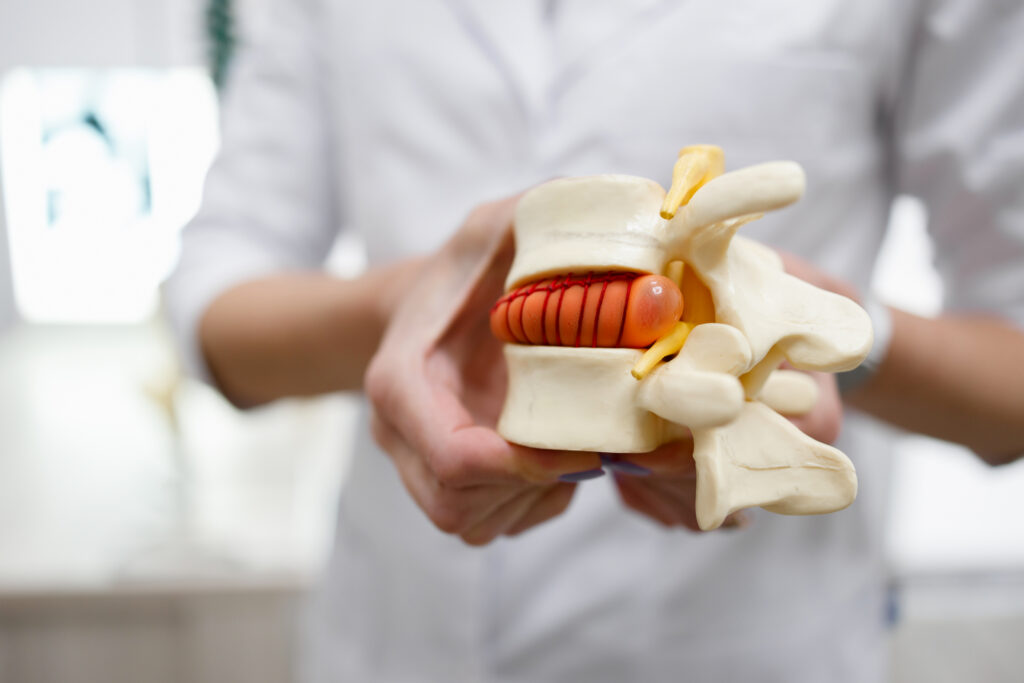
The lumbar spine consists of five vertebrae, labeled L1 through L5.
Within the spine are spaces that accommodate neurological structures.
Lumbar spinal stenosis occurs when these spaces become narrowed.
Depending on the location, narrowing may involve the:
- Central spinal canal
- Lateral recesses
- Neural foramina
These regions contain or surround nerve structures that contribute to sensation and movement in the lower extremities.
The term stenosis simply means narrowing.
But the presence of narrowing does not automatically mean the patient has a symptomatic neurological condition.
The clinical significance depends on how the narrowing relates to the nerves and the patient’s symptoms.
Lumbar Stenosis Is Commonly Associated With Degenerative Changes
As people age, several spinal structures can undergo changes.
Intervertebral discs may lose height or develop degenerative bulging.
Facet joints may enlarge or develop osteoarthritic changes.
The ligamentum flavum, a ligament along the back of the spinal canal, may thicken or buckle inward.
Together, these changes can reduce the space available for neural structures.
This is commonly called degenerative lumbar spinal stenosis.
It often develops gradually rather than from one dramatic injury.
However, not all spinal stenosis is caused by aging. Some people have a naturally narrower spinal canal, and other structural conditions can contribute.
Why Walking and Standing Can Be More Difficult Than Sitting
The lumbar spine changes shape as the body moves.
When a person stands upright or extends the lower back, the available space in certain regions of the spinal canal and foramina may decrease.
When the person bends forward, some of those spaces may increase.
In a patient with symptomatic stenosis, that positional change can influence nerve-related symptoms.
The result may be a recognizable pattern:
Standing or walking upright → increasing leg symptoms → sitting or bending forward → symptom relief.
This is not universal, but it is clinically useful.
Neurogenic Claudication: The Hallmark Symptom Pattern
The term neurogenic claudication describes symptoms associated with lumbar nerve compromise that are typically provoked by standing or walking.
Patients may experience:
- Aching
- Heaviness
- Burning
- Tingling
- Numbness
- Weakness or a sense that the legs are becoming weak
Symptoms may affect:
- Buttocks
- Thighs
- Calves
- One or both legs
Some patients also experience low-back pain.
Others have relatively little back pain compared with their leg symptoms.
The pattern of activity-related symptoms and positional relief is often more informative than the intensity of back pain alone.
The Shopping Cart Sign
The so-called shopping cart sign refers to improved walking tolerance when a person leans forward on a shopping cart or similar support.
A patient may report that walking upright is difficult but walking while leaning forward feels substantially easier.
That observation may support suspicion for lumbar spinal stenosis with neurogenic claudication.
However, it is not diagnostic by itself.
Other conditions can also make supported walking easier.
The finding becomes more meaningful when combined with:
- Leg symptoms during standing or walking
- Relief with sitting
- Improvement with lumbar flexion
- Compatible examination findings
- Corresponding imaging
Why a Bicycle May Be Easier Than Walking
Some patients with lumbar spinal stenosis tolerate cycling surprisingly well.
When riding a stationary bicycle, the trunk is often positioned in relative flexion.
That posture may be more comfortable than standing upright.
Cycling also changes the mechanical and physiological demands compared with walking.
A patient who can ride a bicycle comfortably but develops leg heaviness after several minutes of upright walking may have a symptom pattern consistent with neurogenic claudication.
But this finding should be interpreted carefully because cardiovascular fitness, hip function, balance, and other factors can influence the comparison.
Lumbar Stenosis Is Not the Same as Ordinary Low-Back Pain
Many patients with mechanical low-back pain experience discomfort during prolonged standing.
That alone does not establish lumbar spinal stenosis.
The distinction becomes more meaningful when standing or walking produces symptoms extending into the lower extremities.
For example:
A patient with localized low-back aching after standing for an hour may have a predominantly mechanical pain presentation.
Another patient whose legs become progressively heavy, numb, or painful after walking a short distance—and whose symptoms improve when sitting—may have a pattern more suggestive of neurogenic claudication.
These conditions can overlap, but they are not interchangeable.
Spinal Stenosis Can Affect One Leg or Both
Although bilateral leg symptoms are common in central lumbar stenosis, symptoms do not have to affect both legs equally.
A patient may report:
- Both legs becoming heavy
- One leg hurting more than the other
- Pain predominantly in one buttock
- Tingling extending into one calf
- Variable symptoms depending on activity
The location of narrowing matters.
Central canal narrowing may produce a different clinical pattern from narrowing that primarily affects one nerve root within a lateral recess or neural foramen.
This is why the anatomical description on MRI must be interpreted alongside the symptoms.
Central Stenosis, Lateral Recess Stenosis, and Foraminal Stenosis
These terms describe different anatomical locations of narrowing.
| Type | Location | Possible clinical presentation |
|---|---|---|
| Central canal stenosis | Main spinal canal | Often associated with neurogenic claudication, potentially involving both legs |
| Lateral recess stenosis | Region where nerve roots travel before exiting | May contribute to symptoms involving a particular nerve root |
| Foraminal stenosis | Opening through which a spinal nerve exits | May produce radicular symptoms corresponding to the affected nerve |
These are general patterns rather than strict rules.
A patient can have narrowing in more than one location.
And a radiology report may describe several abnormalities that do not all contribute equally to the patient’s symptoms.
Severe Stenosis on MRI Does Not Always Mean Severe Symptoms
One of the most important concepts in spinal care is that imaging severity and clinical severity are not perfectly related.
Some people have substantial spinal narrowing on MRI but experience relatively little limitation.
Others develop significant walking intolerance with less dramatic imaging findings.
The MRI helps identify anatomical narrowing.
It does not independently measure:
- Walking endurance
- Leg pain severity
- Balance
- Strength
- Quality of life
- Disability
Those factors require clinical assessment.
The diagnosis of symptomatic lumbar spinal stenosis depends on the combination of anatomical findings and clinical presentation.
“My MRI Says Severe Stenosis. Does That Mean I Need Surgery?”
Not automatically.
The word severe on an MRI describes the radiologist’s assessment of anatomical narrowing.
It does not, by itself, determine whether surgery is necessary.
A patient with severe narrowing but good walking tolerance, stable neurological function, and manageable symptoms may have a different treatment pathway from someone who can walk only a short distance before developing disabling leg symptoms.
Surgical decisions depend on:
- Symptoms
- Function
- Neurological findings
- Structural anatomy
- Response to nonsurgical management
- Overall health
- Patient preferences
The imaging matters.
But the patient’s actual condition matters just as much.
Spinal Stenosis and Sciatica Are Related but Not Identical
Patients often use the term sciatica for pain traveling into the leg.
Lumbar spinal stenosis can produce nerve-related leg symptoms.
However, sciatica is a broad symptom description, while spinal stenosis describes an anatomical narrowing.
A disc herniation may produce radicular pain even without substantial degenerative spinal stenosis.
Likewise, lumbar stenosis may produce bilateral heaviness and walking intolerance rather than the sharp, shooting pain commonly associated with some disc-related radiculopathies.
Understanding the pattern helps guide diagnosis.
Vascular Claudication Can Look Surprisingly Similar
Not all leg pain during walking comes from the spine.
Peripheral artery disease (PAD) can reduce blood flow to the legs and produce exertional discomfort.
This is called vascular claudication.
Patients may describe:
- Calf pain
- Tightness
- Fatigue
- Cramping
- Reduced walking tolerance
That can resemble symptoms associated with lumbar stenosis.
But the underlying problem is different.
Neurogenic Versus Vascular Claudication
Several features may help distinguish the two patterns.
| Feature | Neurogenic claudication | Vascular claudication |
|---|---|---|
| Common trigger | Standing or walking | Walking or exertion |
| Typical relief | Sitting or lumbar flexion | Rest, often without needing to bend forward |
| Effect of posture | Frequently important | Usually less important |
| Symptom location | Buttocks, thighs, calves, or multiple regions | Often calves, though other regions may be involved |
| Important evaluation | Neurological and spinal assessment | Vascular examination and testing |
These distinctions are helpful but not absolute.
A patient can also have both lumbar spinal stenosis and peripheral artery disease.
That possibility becomes particularly important in older adults or patients with vascular risk factors.
Why Peripheral Artery Disease Must Not Be Missed
A patient with vascular claudication may need medical evaluation for atherosclerotic disease and cardiovascular risk.
Depending on the presentation, evaluation may include:
- Peripheral pulse examination
- Skin and circulation assessment
- Ankle-brachial index testing
- Additional vascular studies
A patient whose leg pain is caused by impaired circulation will not be adequately managed by treating the lumbar spine alone.
Sudden severe limb pain with a cold, pale, numb, or weak extremity may indicate acute limb ischemia and requires emergency medical evaluation.
This is an important reason not to assume every walking-related leg symptom is neurological.
Hip Arthritis Can Also Reduce Walking Tolerance
Hip osteoarthritis may produce pain involving the:
- Groin
- Thigh
- Buttock
- Occasionally the knee
Some patients experience substantial walking limitations.
Hip symptoms can overlap with lumbar spine complaints, particularly in older adults who may have both hip arthritis and spinal degeneration.
The examination may therefore assess:
- Hip range of motion
- Groin pain
- Walking mechanics
- Lower-extremity strength
- Lumbar symptom behavior
A patient can have significant lumbar stenosis on MRI while the hip is contributing substantially to the current limitation.
Again, imaging findings should not automatically determine the diagnosis.
Peripheral Neuropathy Is Another Important Consideration
Peripheral neuropathy can produce:
- Numbness
- Tingling
- Burning
- Sensory loss
- Balance difficulties
Symptoms may be associated with conditions such as diabetes or other neurological and metabolic disorders.
Unlike classic neurogenic claudication, peripheral neuropathy may produce persistent symptoms that are not strongly linked to upright walking or lumbar position.
However, the conditions can coexist.
A patient with lumbar stenosis and peripheral neuropathy may require a broader neurological evaluation.
Weakness Needs to Be Examined, Not Just Described
Patients sometimes say:
“My legs feel weak after I walk.”
That may describe fatigue, heaviness, pain-related limitation, or genuine neurological weakness.
Those are not identical.
The examination may include:
- Hip strength
- Knee strength
- Ankle dorsiflexion
- Great-toe extension
- Plantarflexion
- Reflexes
- Sensation
- Gait
Objective weakness becomes especially important when determining whether the patient needs further imaging or specialist evaluation.
Progressive motor loss should not be treated as ordinary age-related stiffness.
Balance Problems Require Additional Clinical Reasoning
Some patients with lumbar spinal stenosis report difficulty walking because their legs become uncomfortable or unreliable.
But balance problems can also arise from:
- Peripheral neuropathy
- Vestibular disorders
- Cervical spinal cord disease
- Neurological conditions
- Medication effects
- Other medical problems
A patient with worsening gait or balance should not automatically be told that lumbar stenosis explains everything.
The pattern and neurological findings matter.
When Bowel or Bladder Changes Become an Emergency
Severe compression of nerve structures in the lower spinal canal can occasionally produce cauda equina syndrome.
This is a medical emergency.
Concerning symptoms may include:
- New urinary retention
- New loss of bladder or bowel control
- Numbness in the saddle or groin region
- New significant bilateral leg weakness
- Other rapidly progressive neurological changes
These symptoms require emergency medical assessment.
Routine conservative treatment should never delay evaluation for suspected cauda equina syndrome.
Can Lumbar Spinal Stenosis Improve Without Surgery?
Yes, some patients with symptomatic lumbar spinal stenosis improve with nonsurgical management.
Potential improvements may include:
- Reduced leg symptoms
- Greater walking tolerance
- Improved strength
- Better conditioning
- Improved functional confidence
- Greater ability to perform daily activities
However, the degree of improvement varies.
Conservative treatment does not necessarily remove the anatomical narrowing.
A patient may function better because their symptoms and physical capacity improve, even while degenerative changes remain visible on MRI.
For some patients, that improvement is sufficient.
For others, symptoms remain substantially disabling.
Exercise Is Often More Useful Than Simply Avoiding Walking
Patients with neurogenic claudication may gradually reduce activity because walking provokes symptoms.
Over time, reduced activity can contribute to:
- Deconditioning
- Lower-extremity weakness
- Reduced cardiovascular fitness
- Lower walking endurance
This can make an already difficult situation worse.
Appropriately selected exercise may help preserve and improve function.
For some patients, a flexion-tolerant exercise approach is more comfortable initially.
That might include:
- Stationary cycling
- Supported walking
- Modified strengthening
- Progressive conditioning
The program should be tailored to the individual’s symptoms and neurological findings.
The Goal Is Not to Force Every Patient Into Perfectly Upright Posture
Patients with spinal stenosis are sometimes told to:
“Stand up straight.”
But forcing lumbar extension may aggravate neurogenic claudication in certain patients.
A slightly flexed position can be a useful temporary strategy for improving activity tolerance.
That does not mean the patient should remain permanently bent forward.
It means rehabilitation should respect the patient’s current symptom behavior while working toward the best achievable function.
There is no universal posture that every patient with stenosis must maintain.
A Walking Program Should Match the Patient’s Actual Tolerance
Suppose a patient develops leg symptoms after five minutes of walking.
Requiring thirty continuous minutes of upright walking may not be a reasonable starting point.
A more individualized approach might use:
- Shorter walking intervals
- Rest breaks
- Supported walking
- Alternative cardiovascular exercise
- Gradual progression
Progress should be judged by symptom response and functional improvement.
The objective is to build capacity without repeatedly producing severe or prolonged neurological symptoms.
Conservative Care and Surgery Are Not Opposing Philosophies
Lumbar spinal stenosis is a condition in which treatment decisions can legitimately vary.
One patient may maintain excellent function through:
- Exercise
- Activity modification
- Medical management
- Other appropriate conservative measures
Another may continue to experience severe neurogenic claudication despite reasonable nonsurgical care.
For that patient, surgical decompression may offer meaningful benefit.
The correct goal is not to avoid surgery at any cost.
It is to determine whether the patient can achieve acceptable function without surgery—and recognize when the balance of benefits and risks favors specialist intervention.
The Most Important Question Is Not Simply “How Narrow Is My Spinal Canal?”
A useful evaluation asks:
Do my symptoms follow the pattern of neurogenic claudication?
Does standing or walking bring on leg symptoms?
Does sitting or bending forward relieve them?
Could vascular disease, hip arthritis, neuropathy, or another condition be contributing?
Are there objective neurological deficits?
Does the MRI match the symptoms and examination?
Can conservative care realistically improve my walking and daily function?
And have my symptoms or neurological findings reached the point where surgical consultation is appropriate?
Those questions turn an anatomical diagnosis into an individualized treatment decision.
How Doyle Chiropractic Evaluates Lumbar Spinal Stenosis
When a patient comes to Doyle Chiropractic with an MRI showing lumbar spinal stenosis, the first priority is determining whether the narrowing is actually responsible for the patient’s symptoms.
Dr. Geoffrey Doyle considers the relationship between the imaging findings, neurological examination, walking tolerance, and everyday functional limitations.
An important part of the evaluation is understanding what happens when the patient stands or walks.
For example:
- How long can the patient stand before symptoms begin?
- How far can the patient walk?
- Do symptoms develop in one leg or both?
- Does sitting provide relief?
- Is walking easier when leaning forward?
- Can the patient ride a stationary bicycle more comfortably than they can walk?
- Are symptoms gradually becoming more limiting?
- Is there measurable weakness or sensory loss?
These details help distinguish symptomatic lumbar spinal stenosis from other causes of back and leg discomfort.
The objective is not simply to confirm that narrowing exists.
It is to determine how much that narrowing is affecting the patient and which treatment pathway is appropriate.
The Physical Examination Looks Beyond the Lower Back
A patient with suspected lumbar spinal stenosis may undergo an examination of several interconnected systems.
Depending on the presentation, this may include assessment of:
- Lumbar movement
- Hip mobility
- Lower-extremity strength
- Reflexes
- Sensation
- Walking mechanics
- Balance
- Functional movement
- Peripheral circulation when indicated
The neurological examination is particularly important when symptoms include weakness, numbness, or altered walking ability.
A patient may have severe radiographic stenosis but relatively preserved neurological function.
Another may demonstrate progressive motor weakness or other findings that require more urgent investigation.
Those patients should not automatically receive the same treatment plan.
Walking tolerance provides a practical baseline
One useful measure is the distance or duration a patient can walk before symptoms become limiting.
For example, a patient may report:
“After about five minutes, both legs start aching and feel heavy. If I sit down for a few minutes, I can get up and walk again.”
That gives us a functional baseline.
If treatment is appropriate, progress can be measured against that baseline.
Can the patient walk farther?
Do symptoms begin later?
Are fewer rest breaks necessary?
Is the patient able to participate in more daily activities?
These changes may be more meaningful than a small difference in a pain score.
Treatment Should Address Both Nerve-Related Symptoms and Physical Capacity
For appropriately selected patients, conservative management may focus on two related goals.
The first is reducing the symptoms associated with neurogenic claudication.
The second is improving the patient’s ability to function despite the underlying degenerative changes.
A treatment program may incorporate:
- Therapeutic exercise
- Progressive lower-extremity strengthening
- Cardiovascular conditioning
- Mobility exercises
- Activity modification
- Education about symptom-provoking positions
- Selected manual treatment
- Medical co-management when appropriate
The precise combination depends on the patient’s presentation.
Importantly, conservative care should not be described as permanently removing the anatomical stenosis.
Its purpose is to improve symptoms and function when nonsurgical management remains reasonable.
Why Strengthening Matters When the Problem Is in the Spine
Patients sometimes wonder why strengthening their legs would help if their MRI shows narrowing in the lower back.
The answer is that walking requires more than adequate space around the spinal nerves.
It also requires sufficient:
- Hip strength
- Quadriceps strength
- Calf strength
- Balance
- Cardiovascular endurance
- Movement coordination
When a patient gradually reduces walking because of stenosis-related symptoms, deconditioning can develop.
That loss of conditioning may further reduce walking capacity.
Appropriate strengthening does not eliminate nerve compression, but it may improve the patient’s ability to perform everyday activities.
The program should be adjusted for neurological findings and symptom tolerance.
Flexion-Based Exercise May Be Helpful for Selected Patients
Because some patients with neurogenic claudication feel better in a slightly flexed position, rehabilitation may initially emphasize movements that are more comfortable in that posture.
Examples may include:
- Seated exercises
- Stationary cycling
- Modified trunk exercises
- Supported lower-extremity strengthening
- Carefully selected mobility work
However, lumbar spinal stenosis does not require every patient to perform the same flexion-based program.
Some patients have additional conditions that change exercise selection.
Others tolerate a broader range of movements.
The clinical objective is to identify a safe and effective starting point and progressively improve capacity.
Chiropractic and Manual Treatment
Chiropractic or manual treatment may be incorporated for selected patients with lumbar spinal stenosis when examination identifies appropriate musculoskeletal findings.
Potential treatment targets may include:
- Lumbar mobility
- Hip mobility
- Thoracic mobility
- Associated muscular restrictions
- Movement-related discomfort
Manual treatment may help some patients participate more comfortably in rehabilitation.
However, an important distinction must be maintained.
Spinal manipulation does not remove osteophytes, eliminate ligament thickening, or permanently enlarge a severely narrowed spinal canal.
The evidence for manual treatment specifically as a stand-alone intervention for lumbar spinal stenosis is limited.
When used, it should be part of a broader, individualized treatment plan rather than a substitute for appropriate neurological assessment.
Patients with progressive neurological deficits, suspected cauda equina syndrome, instability, fracture, or other serious pathology require appropriate medical evaluation.
Nonsurgical Spinal Decompression and Traction
Patients frequently encounter advertisements suggesting that nonsurgical spinal decompression can correct lumbar spinal stenosis.
It is important to distinguish temporary mechanical effects from permanent structural changes.
Traction-based treatments may be considered in selected circumstances, but evidence supporting their effectiveness specifically for degenerative lumbar spinal stenosis is limited.
Nonsurgical decompression should not be presented as a way to:
- Remove bony spinal overgrowth
- Eliminate thickened spinal ligaments
- Permanently enlarge the spinal canal
- Reverse advanced degenerative changes
- Restore progressive neurological weakness
It is also not equivalent to surgical decompression.
For patients with significant stenosis, treatment decisions should be based on clinical findings and realistic expectations rather than claims that a machine can reverse the anatomy seen on MRI.
Class IV Laser Therapy
Class IV laser therapy may be considered as an adjunct for selected musculoskeletal symptoms when clinically appropriate.
However, there is insufficient evidence to conclude that laser therapy reverses lumbar spinal stenosis or reliably treats neurogenic claudication caused by significant structural narrowing.
Laser treatment does not remove:
- Osteophytes
- Thickened ligaments
- Degenerative facet enlargement
- Structural compression of spinal nerves
If used, it should remain an adjunct to a broader management strategy rather than being presented as a definitive treatment for anatomical stenosis.
The Dr. Doyle Perspective
“When a patient tells me they can ride a bike but can’t walk through the grocery store, that gets my attention. It’s a very different story from someone who just has ordinary low-back stiffness. I want to know what happens when they stand, how far they can walk, whether bending forward helps, and what their neurological examination shows. If the MRI confirms stenosis that matches those findings, we have a much clearer picture. Some of these patients can improve their walking and quality of life with the right conservative program. Others have significant nerve compression and limitations that aren’t responding. I’m not interested in keeping somebody in treatment indefinitely when a surgical consultation may offer them a better option. The goal is to help them walk, function, and enjoy their life—not simply to say we treated their MRI.”
— Dr. Geoffrey Doyle, DC
Our Clinical Experience
Consider several patients with lumbar spinal stenosis.
One patient has moderate degenerative narrowing on MRI and notices leg discomfort after walking for fifteen or twenty minutes.
The patient remains active, has no progressive neurological deficits, and can perform most daily activities.
A conservative program emphasizing conditioning, strengthening, and appropriate activity modification may be reasonable.
Another patient has more substantial stenosis and can walk only a few minutes before developing bilateral leg heaviness.
However, sitting provides relief, and stationary cycling remains comfortable.
That patient may also be a candidate for carefully monitored nonsurgical management, depending on the neurological examination and overall clinical picture.
A third patient has severe stenosis with persistent disabling neurogenic claudication despite an appropriate trial of conservative treatment.
The patient’s ability to shop, travel, and perform daily activities has become significantly restricted.
For that patient, surgical consultation may be a very reasonable next step.
A fourth patient presents with worsening leg weakness and increasing difficulty walking.
That situation requires prompt reassessment and appropriate medical or specialist evaluation rather than simply continuing the same treatment.
These examples illustrate an important principle:
The diagnosis may be the same, but the appropriate treatment pathway can be very different.
Medication May Be Part of the Treatment Plan
Some patients with lumbar spinal stenosis may receive medications intended to help manage pain or associated symptoms.
Depending on the presentation, a prescribing clinician may consider:
- Analgesics
- Anti-inflammatory medications
- Other symptom-directed medications
The evidence supporting particular medications for neurogenic claudication varies, and some commonly prescribed drugs may offer limited benefit while carrying meaningful adverse-effect risks.
Medication selection should account for:
- Age
- Kidney function
- Cardiovascular risk
- Other medical conditions
- Potential drug interactions
- Previous treatment response
Medication may be appropriate for selected patients, but it does not reverse structural narrowing.
A patient receiving medical treatment may also participate in appropriately selected rehabilitation.
Epidural Steroid Injections: When They May Be Considered
Epidural steroid injections are sometimes considered for patients with lumbar nerve-related symptoms.
However, their effectiveness depends on the underlying diagnosis.
For neurogenic claudication caused by central lumbar spinal stenosis, evidence does not support expecting reliable, sustained improvement from epidural steroid injections.
Some patients may experience temporary symptom relief, particularly when a radicular pain component is present.
An injection does not permanently enlarge the spinal canal.
The decision should involve discussion of:
- The precise diagnosis
- Expected benefit
- Duration of potential relief
- Procedure-related risks
- Alternative treatments
An injection may be reasonable in selected circumstances, but it should not be portrayed as a dependable long-term solution for severe central stenosis.
When Surgical Decompression May Be the Better Option
Surgical decompression is intended to create more space for affected neural structures.
Depending on the anatomy, procedures may involve removing portions of structures contributing to nerve compression.
Common procedures include lumbar laminectomy or other decompressive techniques.
For appropriately selected patients with symptomatic lumbar spinal stenosis, surgery may improve:
- Leg pain
- Neurogenic claudication
- Walking tolerance
- Daily function
- Quality of life
The likelihood of benefit depends on the diagnosis, anatomy, severity, general health, and other factors.
Surgery also carries risks, and improvement is not guaranteed.
A spine surgeon can explain the expected benefits and limitations for the individual patient.
Does Lumbar Stenosis Surgery Always Require a Fusion?
No.
This is an important distinction.
Decompression and fusion are different procedures.
Decompression aims to relieve pressure on neurological structures.
Fusion is intended to stabilize motion between spinal segments.
Some patients with lumbar spinal stenosis may be candidates for decompression without fusion.
Fusion may be considered in selected circumstances involving instability, deformity, or other relevant structural factors.
The presence of stenosis alone does not automatically mean a patient needs a spinal fusion.
The decision depends on the individual anatomy and surgical assessment.
When Waiting May No Longer Be the Best Strategy
Some patients are reluctant to consider surgery even when walking has become severely limited.
Others are understandably concerned about surgical risks and recovery.
Those concerns deserve a careful discussion.
But if a patient has:
- Persistent disabling neurogenic claudication
- Major loss of walking independence
- Progressive neurological deficits
- Severe symptoms despite appropriate nonsurgical care
continuing the same conservative treatment indefinitely may not be appropriate.
A surgical consultation does not require the patient to proceed with surgery.
It provides an opportunity to understand whether decompression could offer meaningful improvement.
Monitoring Progress During Conservative Care
When conservative treatment is appropriate, follow-up should focus on measurable changes.
Useful questions include:
- Is the patient walking farther?
- Are symptoms beginning later during activity?
- Are fewer rest breaks necessary?
- Is leg heaviness decreasing?
- Has standing tolerance improved?
- Is strength stable or improving?
- Are daily activities becoming easier?
A patient who can walk fifteen minutes instead of five may have achieved a meaningful functional improvement.
But a patient whose pain is slightly reduced while weakness and walking ability deteriorate needs reassessment.
Improvement must be judged across the whole clinical picture.
When Symptoms Require Urgent Medical Attention
Patients with lumbar spinal stenosis should seek prompt medical evaluation for new or worsening neurological deficits.
Particularly concerning findings include:
- Progressive leg weakness
- New foot drop
- Rapid deterioration in walking ability
- Significant new sensory loss
- Other substantial neurological changes
Emergency evaluation is required when cauda equina syndrome is suspected.
Warning signs include:
- New urinary retention
- New loss of bowel or bladder control
- Saddle-region numbness
- New severe or rapidly progressive bilateral neurological symptoms
A patient should not wait for a routine chiropractic appointment if these symptoms develop.
Living With Lumbar Spinal Stenosis Does Not Mean Giving Up Activity
Some patients become so concerned about nerve compression that they begin avoiding nearly all physical activity.
That can lead to additional weakness, deconditioning, and loss of independence.
When medically appropriate, maintaining activity is important.
The objective may be to find ways to remain active through:
- Shorter walking intervals
- Stationary cycling
- Supported exercise
- Progressive strengthening
- Appropriate rest breaks
- Individualized activity modification
The best program is not necessarily the one that produces the least discomfort during every movement.
It is the program that safely improves the patient’s capacity over time.
Frequently Asked Questions
What is lumbar spinal stenosis?
Lumbar spinal stenosis is narrowing within the lower spine that may affect spinal nerve structures. It commonly develops from degenerative changes involving discs, facet joints, and ligaments.
What are the most common symptoms?
Symptomatic lumbar spinal stenosis may cause leg pain, heaviness, numbness, tingling, or weakness during standing or walking. Symptoms often improve with sitting or bending forward.
Why can I walk farther when leaning on a shopping cart?
Leaning forward changes lumbar spinal positioning and may increase available space around certain nerve structures. This can reduce neurogenic claudication symptoms in some patients.
Why can I ride a bicycle but struggle to walk?
Cycling often places the lumbar spine in a more flexed position than upright walking. That posture may be better tolerated by some patients with neurogenic claudication.
Can spinal stenosis cause leg pain without back pain?
Yes. Some patients experience predominantly buttock or leg symptoms with relatively little low-back discomfort.
Does severe spinal stenosis on MRI mean I need surgery?
Not automatically. Surgical decisions depend on symptoms, functional limitation, neurological findings, structural anatomy, response to nonsurgical treatment, and patient preferences.
Can lumbar spinal stenosis improve without surgery?
Some patients experience meaningful improvements in symptoms and walking tolerance with appropriate conservative management. However, nonsurgical treatment generally does not remove the underlying degenerative narrowing.
Can exercise help spinal stenosis?
Yes. Appropriately selected exercise may improve strength, conditioning, mobility, and walking capacity. Programs should be individualized according to symptom response and neurological findings.
Should I avoid standing and walking?
Not necessarily. Activity may need to be modified, but complete avoidance can contribute to deconditioning. A structured program may use shorter walking intervals, rest breaks, or alternative exercises.
Can chiropractic treatment help lumbar spinal stenosis?
Selected patients may benefit from conservative management that includes exercise, education, and appropriately selected manual treatment. Chiropractic treatment does not eliminate advanced structural stenosis and should not delay necessary neurological or surgical evaluation.
Does spinal decompression reverse stenosis?
Nonsurgical traction-based decompression has not been shown to reliably reverse degenerative lumbar spinal stenosis. It does not remove bone spurs or thickened ligaments.
Can Class IV laser therapy open the spinal canal?
No. Laser therapy does not remove the structural changes responsible for spinal canal narrowing.
Are epidural steroid injections effective for spinal stenosis?
They may provide temporary relief in selected circumstances, but evidence does not support expecting reliable long-term improvement in neurogenic claudication from central lumbar spinal stenosis.
How can I tell whether my walking pain is coming from my spine or circulation?
Neurogenic claudication often improves with sitting or bending forward. Vascular claudication is more closely associated with exertion and often improves with rest regardless of posture. The patterns overlap, so clinical examination and vascular testing may be necessary.
Can spinal stenosis cause permanent nerve damage?
Significant or prolonged nerve compression can sometimes be associated with persistent neurological deficits. Progressive weakness or other worsening neurological findings require prompt evaluation.
When should I see a spine surgeon?
Consultation may be appropriate when symptoms remain substantially disabling despite appropriate conservative management, when significant neurological deficits are present, or when imaging and clinical findings suggest a surgically treatable condition.
Does spinal stenosis surgery always require fusion?
No. Some patients may undergo decompression without fusion. Fusion is considered selectively based on instability, deformity, and other anatomical factors.
When is lumbar spinal stenosis an emergency?
Suspected cauda equina syndrome, including new urinary retention, loss of bowel or bladder control, saddle anesthesia, or severe progressive neurological changes, requires emergency medical evaluation.