Expertise provided by Dr. Doyle, Geoffrey A Doyle
“I just want to know what you’re going to do to my back before you do it” is a fair thing to ask, and it’s one of the most common things people say when they call us. Maybe your back has been talking to you for weeks, or your neck locks up every time you turn to check your blind spot. Either way, you’ve probably started reading up on chiropractic techniques in Huntersville and found a long list of names with no explanation. This page covers every method Doyle Chiropractic in Huntersville, NC uses, who may get which one and why, how gentle each one is, and how we decide when you may be ready for more.
A lot of people who call us have been adjusted somewhere before, and either it felt like too much too soon, or they felt better for a short time and then returned to where they started. If that sounds like you, it makes sense that you’d want to know the game plan before you lie down on a table, and you should know it. Nothing here gets done to you that you didn’t understand and agree to first.
Which Chiropractic Techniques Does Doyle Chiropractic Use?
Doyle Chiropractic uses Diversified as its go-to adjustment, along with gentle prone adjustments, drop table adjustments, activator, and seated adjustments when needed. Cox flexion-distraction is used for people with acute low back pain, disc issues, and arthritic backs. ART is part of the soft tissue side of care, not an adjustment.
The adjusting is done by Dr. Geoff Doyle, the owner and lead doctor, who is a second generation chiropractor and acupuncturist, and by associate doctor Dr. Pedro. Both work from the same toolkit, and that toolkit is wider than most people expect. When you picture a chiropractor, you probably picture one move, a quick hands-on adjustment. That’s Diversified, and it’s a big part of what we do, but it’s one tool out of several, and often times it isn’t the first one you’ll get.
The National Center for Complementary and Integrative Health notes that chiropractors may use a variety of treatment approaches, even though adjustments are the main one. That range is why it helps to know what a specific office actually does. Plenty of clinic websites list every technique name out there, and we’d rather be straight with you about what’s on our list and what isn’t. What you receive is a plan built from the methods on this page and matched to how your body presents on the day you come in: a specific technique, chosen for a specific reason, that you understand before it happens.
Will It Crack, and Will It Be Gentle? The Technique Decoder
Most patients at Doyle Chiropractic start with a gentle-first option such as gentle prone adjustments, activator, or Cox flexion-distraction, and Diversified, the more traditional hands-on adjustment, may be added once the area is ready for it. Here’s a quick guide to the chiropractic techniques Huntersville patients may receive at our office, who each one often suits, and where it sits on the gentle scale.
| Technique | What it is | Who it often suits | Where it sits on the gentle scale |
|---|---|---|---|
| Diversified | The traditional hands-on adjustment, where the doctor’s hands guide a specific joint to help restore motion | Patients past the acute stage, or those who prefer a traditional adjustment | The more traditional option and our go-to once you’re ready |
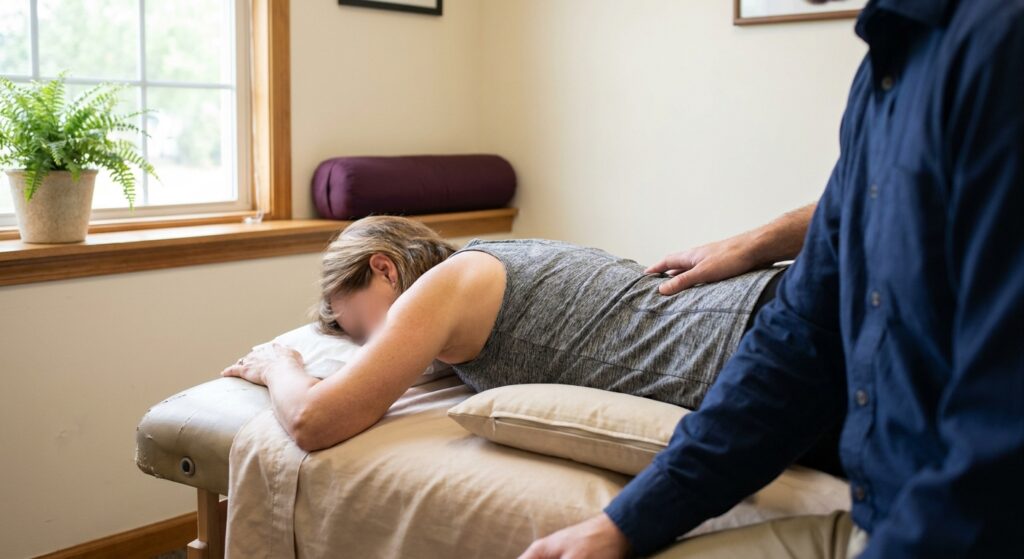
| Gentle prone adjustments | Adjustments with you lying face down, using gentle traction-style pressure | People with acute low back pain, pregnancy (with a tummy pillow), arthritis | A gentle-first starting point |
| Drop table | A section of the table drops a short distance as the adjustment is given, so the table assists | Patients who are calming down and ready to progress | Added as you become less acute |
| Activator | A small handheld instrument that delivers a quick, low-force adjustment | People with acute pain, arthritis, or who dislike aggressive adjustments | A gentle-first option |
| Seated adjustments | Adjustments given while you sit upright | Patients who are more comfortable seated, including some people with arthritis | Used when needed |
| Cox flexion-distraction | A specialized table gently flexes and tractions the low back | People with acute low back pain, disc issues, older or arthritic backs, or who dislike aggressive adjustments | A gentle-first option |
Cox flexion-distraction is the one people ask about most, so here’s a simple way to picture it. Think of a garden hose with a pinch in it. Pushing down hard on the pinched spot doesn’t get the water moving, but gently opening up the bend may. Cox is built on that same idea for a low back that’s irritated, crowded, or arthritic: instead of pushing on the problem, it slowly aims to create room around it. That’s why it often makes sense when a back is too irritated for a traditional adjustment.
Now for the “does it crack” question. Not every technique on this list involves the twist you might be bracing for, since several of these tools are low-force by design, and everyone’s experience is a little different. If a past adjustment left you uneasy, or the idea of a sound coming from your spine makes you tense up, tell us on day one. That’s useful information, not a complaint, and it helps us choose where to start.
Who Gets Which Technique on the First Visit, and Why?
Knowing the tools is one thing, but the bigger question is how the doctor picks one for you. At Doyle Chiropractic, technique choice comes down to two things: how you present and what you prefer, as long as it’s safe and you’re progressing. Most people start gentle and move up only as the body allows.
On your first visit, the doctor evaluates the specific tissues that may be contributing to your symptoms, including your dermatomes, myotomes, and reflexes, so the starting technique matches what the exam finds. Chiropractic is commonly used for people with back pain, neck pain, joint pain, and headaches, as Harvard Health describes. Those complaints can come from very different tissues, though, so the same label doesn’t mean the same plan. Here’s how the decision may play out for people we see in Huntersville, NC.
If you have an acute low back. Say your back went out this week and getting out of the car has turned into a project. You’ll usually start with gentle prone traction adjustments, and maybe activator, and as the area becomes less acute and stops guarding, Diversified or drop table may be added. We don’t start with the strongest tool just because it’s the most familiar one. The American Chiropractic Association’s research summary points to spinal manipulation as a recommended nondrug option for low back pain, and the key is applying it at the right moment for your back.
If you have arthritis or a disc issue. Here, less is often more. Dr. Doyle errs toward the gentle end with gentle traction, Cox flexion, activator, gentle prone, or seated adjustments, and Diversified is added only if it’s needed. Older patients with arthritic backs often stay on this gentler side for a good while, and that’s fine, because the goal is supporting function, not delivering a bigger adjustment.
If you are pregnant. You get a tummy pillow and prone adjustments, so you can lie face down comfortably while the work is done. Talk through your individual circumstances with the doctor, and keep your OB in the loop as well.
If you sit at a desk all day or log miles on the greenway. Maybe you commute and sit through long workdays, or you’re a runner with a tight hip. The same rule applies to you: we evaluate first, start where your tissues allow, and move forward as you show you’re ready. Along the way, we reevaluate how you’re doing, including your VAS score (a 0 to 10 pain rating) and how your ADLs, your normal daily activities, are going.
How Does Dr. Doyle Know You’re Ready for More? The Dress Rehearsal
Moving from gentle work to a fuller adjustment isn’t a guess. Before any fuller adjustment, Dr. Doyle sets you up in the exact adjustment position and applies only part of the pressure, roughly 50 to 70%, to check whether your body is ready. If you handle that well, he can go ahead, and if you guard, the plan stays on the gentler side for now.
Think of it as a dress rehearsal before opening night. Actors run the whole scene in costume on the real stage before there’s an audience, so if something’s off, they find out when it doesn’t matter yet. The readiness check works the same way. You’re already in position and feeling what the adjustment will be like at a fraction of the force, so both you and the doctor get honest feedback before anything more happens.
Why go through this extra step? A guarded, restricted area may tighten up against a full adjustment, and forcing it doesn’t help. Often times the tissue just needs another visit or two of gentle work, traction, or soft tissue care before it’s ready, and the dress rehearsal helps show which way to go. It also gives you some control, because you feel the setup first and nothing comes as a surprise.
This step is one of the clearest examples of the no-pressure approach at Doyle Chiropractic. You won’t be rushed into the strongest technique on the first visit. You move forward when your body says yes.
ART Is Soft Tissue Work, Not an Adjustment, and Where Other Tools Fit
Adjustments are only part of the picture, and this is where many technique lists get muddy. ART is a soft tissue technique for adhesions and tight muscle, and it isn’t used to move a bone. At Doyle Chiropractic, soft tissue work like ART, massage therapy, cupping, and manual therapy sits next to the adjustments, while decompression, Class 4 laser, acupuncture, and the red light bed are used for purposes an adjustment doesn’t address.
Let’s keep it simple. An adjustment works on a joint. Soft tissue work focuses on the muscle and fascia around that joint, the tight and tender fibers you can often feel with your own fingers. Cupping and massage are used when soft tissue is involved, with the aim of addressing adhesions and inflammation, and ART and manual therapy belong in that same group. If your concern is mostly a stuck joint, the adjustment may be the main tool, and if it’s mostly irritated muscle, soft tissue work moves up the list. Often it’s some of both.
If you’ve tried chiropractic before and it didn’t last
This is the part we could talk about till we’re blue in the face, because it’s a reason many people give up on chiropractic. An adjustment can help restore motion to a joint, but if the tissues around that joint are still damaged or inflamed, relief may not hold, and some people find themselves back where they started a week later. That’s why Doyle Chiropractic doesn’t rely on adjustments alone. It’s also what comprehensive solutions under one roof means here: instead of sending you across town for each piece, we can address the joint, the soft tissue, and the repair side of the problem in the same visit.
How the layers work together
Adjustments and laser are the cornerstone treatments at Doyle Chiropractic, and other tools build off those two. Each added tool has a specific purpose:
- Decompression is intended to create space that an adjustment doesn’t, so it’s used for people with disc problems or arthritis.
- Class 4 laser is used with the aim of supporting tissue repair in muscles, nerves, and discs.
- Acupuncture is used mainly for pain and symptom management, and Dr. Doyle is trained as an acupuncturist as well as a chiropractor.
- Red light bed therapy can be added as a whole-body option intended to support recovery between visits.
These extras usually come at the end of the visit, after the adjustment.
Here’s how a plan looked for one patient with degenerative joint and disc disease. The plan combined adjustments, decompression, laser, and cupping. The adjustments were used to move the vertebrae through their ranges of motion, decompression aimed to make room the adjustment couldn’t, cupping targeted soft tissue adhesions and inflammation, and the laser was used to support tissue repair. The idea behind layering is to give the tissues what they need so the body can do its part. That is one person’s experience, and plans differ for each patient.
How Many Visits Will You Need, and What Will It Cost?
Once people understand the techniques, the next question is almost always about time and money, and that’s a fair thing to worry about when you’re already frustrated and hurting. The honest answer is that it depends on what the exam finds, which is why nobody at Doyle Chiropractic will hand you a big package on day one before we know what’s going on. You get a game plan after your evaluation, and then we reevaluate and re-exam along the way, checking your VAS score, your FRI (a questionnaire that tracks how pain affects your daily function), and your ADLs, so you can see how you’re doing over time and not just how you feel for an afternoon.
If you’re progressing, the plan moves forward, and visits may spread out over time. If you’re not progressing the way we’d expect, we change course instead of repeating the same thing and hoping.
On the money side, Doyle Chiropractic and Acupuncture accepts Aetna, Blue Cross Blue Shield, Medicare, UnitedHealthcare, and cash pay. Call the office to verify your specific benefits before your first visit, and ask about cash-pay pricing too, so you know your out-of-pocket costs up front and nothing on your EOBs catches you off guard.
What Else Do Huntersville Patients Ask Before Their First Adjustment?
These are the questions people ask most when they call Doyle Chiropractic. If yours isn’t here, ask it on the phone, because no question is too basic.
Which chiropractic techniques does Doyle Chiropractic use in Huntersville?
Diversified is the go-to adjustment, and it’s paired with gentle prone, drop table, activator, seated, and Cox flexion-distraction options depending on how you present and what you prefer.
Will my adjustment hurt or crack?
Gentle prone adjustments, activator, and Cox flexion-distraction are all gentle options, and they’re often where people start. Diversified is the more traditional adjustment. Technique is chosen with your comfort and preference in mind, and experiences vary from person to person, so if something about past care bothered you, tell the doctor and the plan can be adjusted around it.
What is the difference between Diversified and Cox flexion-distraction?
Diversified is a hands-on joint adjustment, while Cox uses gentle traction and flexing on a specialized table. Cox is often chosen for people with acute low back pain, disc issues, older or arthritic backs, or who dislike aggressive adjustments.
Is ART the same as a chiropractic adjustment?
No. ART is soft tissue work for adhesions and tight muscle, and it isn’t used to move bone. It sits alongside massage, cupping, and manual therapy on the soft tissue side of care.
Can I choose which technique I receive?
Yes, your preference matters alongside your presentation and safety. If you dislike aggressive adjustments, say so, because as long as the technique is safe and you’re progressing, your preference carries real weight in the plan.
Are chiropractic adjustments safe during pregnancy?
At Doyle Chiropractic, pregnant patients are positioned with a tummy pillow and receive prone adjustments, so they can lie face down comfortably. Every pregnancy is different, so discuss your individual circumstances with the doctor and with your OB.
Ready to Tell Us What You Want, and What You Don’t?
The simplest next step is to call Doyle Chiropractic and Acupuncture in Huntersville, NC and book a visit. When you call, tell the team which techniques you want to avoid or want to try, and ask them to verify your insurance benefits. Dr. Geoff Doyle or Dr. Pedro will evaluate your situation, start you where your body allows, and walk you through every step before it happens. As Dr. Doyle tells patients, “I’m on your team and we’re gonna try and make things right for you.”
Before you call, jot down two things: any adjustment you’ve had before that you didn’t like, and the one daily activity you most want to get back to, whether that’s sleeping through the night, picking up your kids, or getting back on the greenway. Of all the chiropractic techniques Huntersville offices list online, the right one for you is the one that fits what your tissues need today and what you’re working toward. Those two quick notes tell the doctor exactly that, and they take less than a minute to write.
Not Sure Which Technique Fits You?
Reading about Diversified, Cox, and ART is one thing, but figuring out which approach makes sense for your own back, neck, or stiffness is another. It is completely normal to wonder whether a gentle option exists or whether a technique you read about is right for you. Give Doyle Chiropractic in Huntersville, NC a call, and we will talk through your questions and what to expect from a chiropractic adjustment.
Individual experiences and results vary.