Expertise provided by Dr. Doyle, Geoffrey A Doyle
You have already tried pills, stretches, maybe a new pillow or better shoes, and now someone wants to shine a light on your sore joint, so it is fair to ask whether laser is real or just hype. Does cold laser therapy actually work? Some people whose pain comes from injured or worn-down tissue report that it helped, but it is not a one-time zap that switches the pain off. At Doyle Chiropractic in Huntersville, NC, laser is a tissue-support tool used over a series of visits, and it only goes into a care plan after an exam shows which tissue may be causing the problem.
This guide follows the order Dr. Geoff Doyle uses with patients in the office. It covers what you should know before you start, how the laser is thought to work, how the office decides whether you may be a good fit, and what a visit feels like. After that come when some people notice a change, how progress gets measured, and how cost works. By the end, you should be able to decide whether your pain is worth an evaluation and what a course of laser care may look like.
Before You Start: Does Cold Laser Therapy Actually Work?
Laser therapy is used as a tool matched to the specific tissue that may be injured, and any change tends to build across a course of visits rather than appear after one session. The evidence is stronger for some conditions than others, so the answer depends on what is actually wrong.
First, a quick word on names, because they confuse a lot of people. “Cold laser” is what most people type into a search bar. The term usually refers to low-level laser devices that are described as non-thermal. Doyle Chiropractic offers Class 4 laser therapy, a higher-powered device in the same family of light-based treatment, with settings for different tissues. So when you see “cold laser” on this page, that is the search term. The treatment offered in the office is Class 4.
Second, it helps to know where the research stands. Laser therapy has been studied for years, and the results are not the same across every condition. A technology assessment on low-level laser therapy from Washington State’s Department of Labor and Industries reviewed the published research and found mixed results, with study quality and outcomes varying from one condition to the next. That is why nobody can honestly promise that laser will change your pain, and why this page does not.
Third, think about whether you resemble the kind of patient the office considers for laser. People with tissue-based pain are the ones Doyle Chiropractic most often considers for it. That includes soft tissue injuries, frozen shoulder, plantar fasciitis, and arthritis in the spine, knees, hips and other joints. If your pain does not trace back to a tissue the exam can find, laser may not be a fit, and you deserve to hear that before you spend a dollar on it.
Step 1: How Does Cold Laser Therapy Work?
Laser therapy sends light energy through the skin and into the tissue underneath, where cells absorb it. One widely cited explanation is that the mitochondria, the small energy centers inside each cell, take in that light and make more ATP, which is the fuel cells use to repair themselves.
Think of an injured tendon or an arthritic joint as a construction site that has run low on supplies and workers. The tissue repairs itself slowly, and inflammation often gets in the way. Light-based therapy is commonly described as increasing blood flow to the area, which may bring in more oxygen and nutrients and help carry off the inflammatory waste that builds up around an injury. The idea is that more fuel, better supply lines and less clutter may give the tissue a better setting for its own repair work.
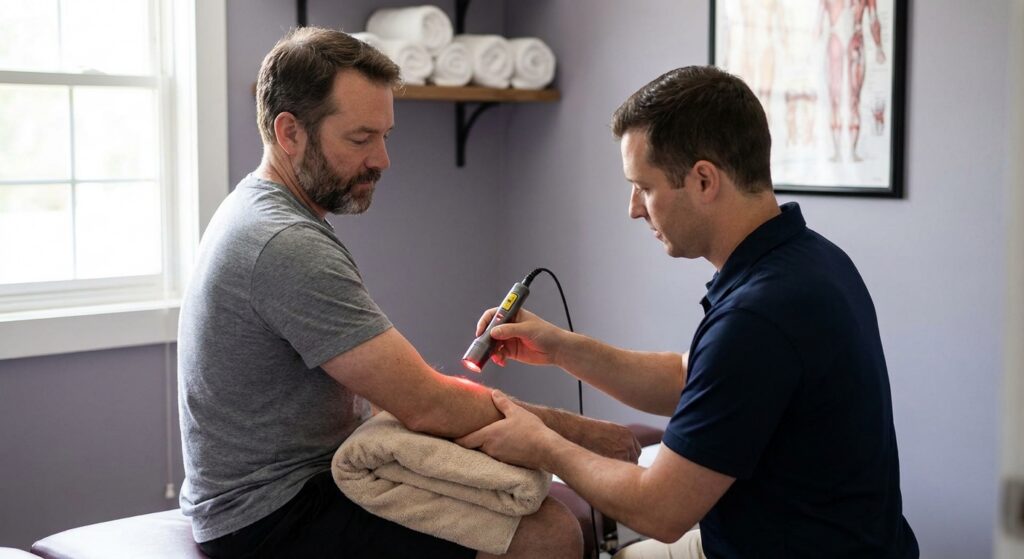
The treatment is non-invasive. Nothing breaks the skin, and there are no needles or injections. Classic low-level cold lasers are described as producing no heat, sound or vibration. The Class 4 laser at Doyle Chiropractic delivers more power and can be set for different tissue types. In Dr. Doyle’s words, the laser “has settings for almost every tissue in the body,” which is why the office uses it on muscles, ligaments, tendons, nerves and other tissues instead of treating every sore spot the same way.
One example from Dr. Doyle’s car accident work shows how this fits into care. When an exam shows that a ligament has been overstretched and the joint may be a little unstable, he may brace that area for two to four weeks while treating it. Laser is one of the tools he may use alongside that bracing, as part of an effort to support the ligament’s healing. He has said that with the Class 4 laser, he can offer tissue-focused care that he was not able to offer before he had it.
Step 2: Get an Evaluation to See If Laser Fits Your Condition
Before laser goes on your plan, Doyle Chiropractic examines you to find out which tissue may be causing your pain. If laser does not fit what the exam finds, it should not be on your plan.
The first visit starts with a conversation about your history and how the pain started, because something as simple as heavy bench pressing can point the doctor toward a specific area. From there, the evaluation includes digital x-rays if needed and hands-on palpation of every spinal level and any symptomatic joint. It also includes motion palpation to find joints that are restricted, plus range of motion measured in each direction with the percent of reduction noted. Dr. Doyle feels for tight and tender fibers, heat and guarding. Neurological testing covers dermatomes, myotomes and reflexes, and orthopedic tests help show whether the tissue he suspects is involved. Referral patterns matter too. Shoulder pain, for example, can come from the neck, the upper back, the chest muscles, or even the gallbladder in someone with GI issues.
This is the opposite of a cookie-cutter model. Once the problem tissue is identified, the plan is built around supporting and maintaining that tissue, and laser is only one of the tools on the table. Here is how Doyle Chiropractic uses each one:
| Treatment | What the office uses it for |
|---|---|
| Class 4 laser | A tool for tissue-focused care, and a component of many plans |
| Chiropractic adjustments | Addressing motion in restricted joints, using gentle prone, seated, drop table, activator and diversified approaches |
| Acupuncture | Pain and symptom management, often alongside laser because the two serve different purposes |
| DOC decompression | Disc problems or arthritis that may call for more space between bones |
| Cupping and manual therapy | Soft tissue involvement in muscles, ligaments, tendons and fascia |
| Red light bed | Whole-body inflammation, skin conditions, sleep trouble and athletic recovery |
You may be wondering how this compares to pain relievers or injections. Those are mainly aimed at quieting symptoms, and they have a real place in medical care. At Doyle Chiropractic, laser is used for a different purpose: supporting the tissue itself. Any decision about a prescription or an injection belongs with your medical doctor, so never stop a medication without talking to whoever prescribed it.
Doyle Chiropractic only accepts patients it believes it can help, and it refers others to appropriate doctors or facilities. After the exam, Dr. Doyle typically lays out a couple of options and up to about four. He sets aside the ones that seem less suited or less worthwhile for your situation, and you can decide on the spot or take time to think it over. Because chiropractic, laser, acupuncture, decompression, cupping and the red light bed all sit under one roof in Huntersville, and same-day availability is often possible, your evaluation and your first treatment can often happen in the same visit.
Step 3: What Happens in a Laser Visit?
A laser session at Doyle Chiropractic runs about 15 to 20 minutes, and patients are advised to get adjusted on the same day.
When you arrive, your schedule is already set. The staff knows the therapies, knows which room you are heading to next, and moves you through without anyone guessing. Laser and decompression take the longest at about 15 to 20 minutes each, so the office builds in roughly five minutes of flexibility to fit in a cupping session or an adjustment between them when needed.
The order is flexible in a way that respects your time. If you are running behind, you go straight to laser and get adjusted afterward. The adjustment is intended to help address joint, muscle and nerve function. Decompression works differently. If decompression is on your plan, the office strongly encourages getting adjusted first, since the office finds that this sequence works better and may help reduce soreness and muscle spasms.
Many people expect the adjustment part to be rough, like the videos they have seen online. At Doyle Chiropractic, the approach is gentle and slow, especially for arthritis and disc cases, where less is more. A typical laser day might look like this: a quick check of how you are doing, an adjustment, your 15 to 20 minute laser session on the problem area, and cupping or acupuncture if your plan calls for it, all in one trip.
Step 4: When Might You Notice a Difference?
Dr. Doyle says that in his 23 years of practice, some patients at Doyle Chiropractic have begun to respond to laser around the halfway mark of their treatment course, though timing differs from person to person. Any effect tends to build over time, so the first few visits are laying groundwork.
Dr. Doyle uses the Class 4 laser almost every day in the office and describes it as a valuable part of his practice. He is equally clear that it is not instant. “You don’t do it once and it’s immediately there,” he says. “It’s kind of like taking medications or doing vitamins or exercising.” Nobody expects one trip to the gym to change their body, and laser follows the same logic.
In cases where laser fits the tissue problem, Dr. Doyle has seen some patients report changes after that halfway point in range of motion, function, and how much they can enjoy their work, their relationships and their weekends. That is his clinical observation, not a prediction of how your course will go. The office emphasizes getting properly evaluated instead of settling for an approach that only addresses symptoms, so the care plan can focus on supporting the tissue and maintaining it over time.
The office uses laser on a range of concerns including soft tissue injuries, major trauma, neurological conditions, frozen shoulder, plantar fasciitis, and arthritis in the spine, knees, hips, shoulders, toes and fingers. Dr. Doyle has also used it with patients who have GI complaints and bladder control issues. Treat those uses as his personal clinical experience, not as established uses of laser therapy. If you reach the halfway point and notice no change at all, tell the doctor, because that is exactly what the re-evaluation step is for.
Step 5: How Do You Know It Is Working?
You find out whether laser is helping by being re-measured with the same objective tests from your first exam, not because someone tells you it is. If the numbers are not moving, the plan gets revisited.
At Doyle Chiropractic, progress tracking uses percent of normal range of motion in each direction, the VAS pain score, the Functional Rating Index (FRI), which looks at how pain affects your ADLs, and the same neurological and orthopedic tests from day one. Before every adjustment, the doctor checks and tests the area so he knows where you stand that day. The office also keeps a record of your last adjustment and how you responded, which helps decide whether to stay the course or try something different.
Here is an illustrative scenario. You come in with a stiff, painful shoulder that only lifts partway. Your first exam records how far it moves in each direction, your VAS score, and which orthopedic tests reproduce your pain. At your re-exam, those same numbers get checked again. If your range of motion and pain score have changed, you have measurable information. If they have not, you have measurable information about that, too. When progress stalls, the doctor re-evaluates and revisits the original recommendations, which is when laser or another treatment may be added, and imaging can help look for reasons why.
This process is led by Dr. Geoff Doyle, a second-generation chiropractor and acupuncturist with more than 20 years in practice and a recipient of the Top 25 Doctors of Chiropractic national award. What matters most for you, though, is the habit behind the measuring: test before treating, re-test on schedule, and change the plan when the numbers suggest it.
Step 6: How Much Does Cold Laser Therapy Cost, and Is It FDA Approved?
Doyle Chiropractic does not publish a flat per-session price for laser, because your cost depends on your insurance, your condition and the number of visits your exam calls for. The office offers several payment options and payment arrangements, has some discounts available in certain situations, and verifies your insurance so you know what to expect.
On insurance, Doyle Chiropractic is in-network with Cigna. It also accepts Aetna, Blue Cross Blue Shield, UnitedHealthcare and Medicare, and cash pay is available. Coverage varies by treatment, so do not assume your plan treats laser the same way it treats an adjustment. Payers look at evidence one condition at a time. For example, Medicare’s national coverage decision on infrared therapy devices, a related category of light-based devices, found the evidence was not adequate to cover them for peripheral neuropathy, wounds and ulcers. For more detail on how plans handle this care, here is a closer look at how cold laser therapy and your insurance fit together.
Dr. Doyle is upfront that insurance can be confusing. There are thousands of plan variations, and once in a while the explanation of benefits (EOB) comes back different from what Doyle Chiropractic was told during verification. When that happens, the office tells you right away and works to refile or fix what it can. Dr. Doyle sometimes adds a little extra treatment on his own dime when a patient had to deal with a billing headache, even when it was not the office’s fault. As he puts it, “I’m on your team and we’re gonna try and make things right for you.”
Is cold laser therapy FDA approved?
Laser therapy devices are generally cleared by the FDA rather than approved, and that clearance applies to specific uses of a specific device, not to every condition someone might treat with it. The Washington State technology assessment discusses how FDA clearance for low-level laser devices has been tied to specific indications. If clearance status matters to you, ask about the device and the use in question during your evaluation. This page makes no claim about the clearance status of any particular device.
What Else Do Huntersville Patients Ask About Cold Laser?
Most remaining questions come down to comfort, number of visits, insurance and fit. The short answers: it is non-invasive, your exam informs the number of visits, coverage depends on your plan, and not everyone is a good candidate.
Does cold laser therapy actually work for pain?
Some people whose pain comes from injured or degenerated tissue report that it helped, and any change tends to build over a course of visits. The research is stronger for some conditions than others, which is why Doyle Chiropractic examines the tissue first.
Is cold laser therapy the same as Class 4 laser therapy?
They belong to the same family of light-based treatment, but they are not identical. “Cold laser” is the common search term for low-level devices, and Doyle Chiropractic uses a Class 4 laser with settings for different tissues.
Does cold laser therapy hurt?
Laser therapy is non-invasive, and nothing breaks the skin. Classic cold lasers are described as producing no heat, sound or vibration.
How many cold laser sessions will I need?
Sessions run about 15 to 20 minutes. Dr. Doyle says some patients at Doyle Chiropractic have begun responding near the halfway mark of their course, and your exam findings inform the length of that course.
Does insurance cover cold laser therapy in Huntersville?
Coverage varies by plan and by treatment. Doyle Chiropractic verifies your benefits, is in-network with Cigna, accepts Aetna, Blue Cross Blue Shield, UnitedHealthcare and Medicare, and offers cash pay.
Who may not be a candidate for cold laser?
People whose exam does not point to a tissue problem laser may address. Doyle Chiropractic refers patients out when it does not believe it can help, and it re-examines anyone whose progress stalls.
What a Course of Laser Care May Look Like
A course of laser care is a series of short visits, paired with same-day adjustments and measured against your starting numbers, with any change often noticed around the middle of the course. Some patients experience gradual change rather than overnight difference, and the plan adjusts based on what the re-exams show. So, does cold laser therapy work for you? The exam and the re-exam numbers are how you find out.
What are the potential benefits of cold laser therapy?
When laser fits your condition, here is what it offers:
- Non-invasive, with no needles or incisions
- Commonly described as supporting circulation, oxygen and nutrient delivery, and removal of inflammatory waste
- Commonly described as possibly helping calm inflammation around injured tissue
- Intended to support the tissue’s own repair process
- Fits into the same visit as your adjustment at Doyle Chiropractic
What conditions does Dr. Doyle use cold laser for?
Conditions Dr. Doyle reports using laser for at Doyle Chiropractic include:
- Soft tissue injuries
- Overstretched ligaments after car accidents
- Major traumas
- Neurological problems, where the research is more limited
- Frozen shoulder
- Plantar fasciitis
- Arthritis of the spine, knees, hips, shoulders, toes and fingers
No two courses look the same, because no two people walk in with the same tissue problem. That is why the approach at Doyle Chiropractic is personalized care tailored to you, with comprehensive options under one roof and no pressure to commit before you are ready.
Book an evaluation at Doyle Chiropractic in Huntersville, NC so Dr. Doyle can examine your tissue, tell you honestly whether laser may be a fit, and often schedule it with your adjustment the same day. Before you come in, write down the three everyday activities your pain limits most, whether that is lifting your arm to a shelf, walking the dog or sleeping through the night. Those become the real-life markers your re-exam measures against, so you can track your own progress.
Curious Whether Cold Laser Therapy Fits Your Situation?
It’s reasonable to be skeptical of a treatment you can’t feel working right away, and the best way to settle that is to talk it through with someone who can look at your specific pain. The team at Doyle Chiropractic in Huntersville, NC can answer your questions about cold laser therapy and how it may fit alongside chiropractic adjustments. Give the office a call and ask what a first step could look like for you.
Individual experiences vary. This article is for general education and does not replace an exam or advice from your own doctor.