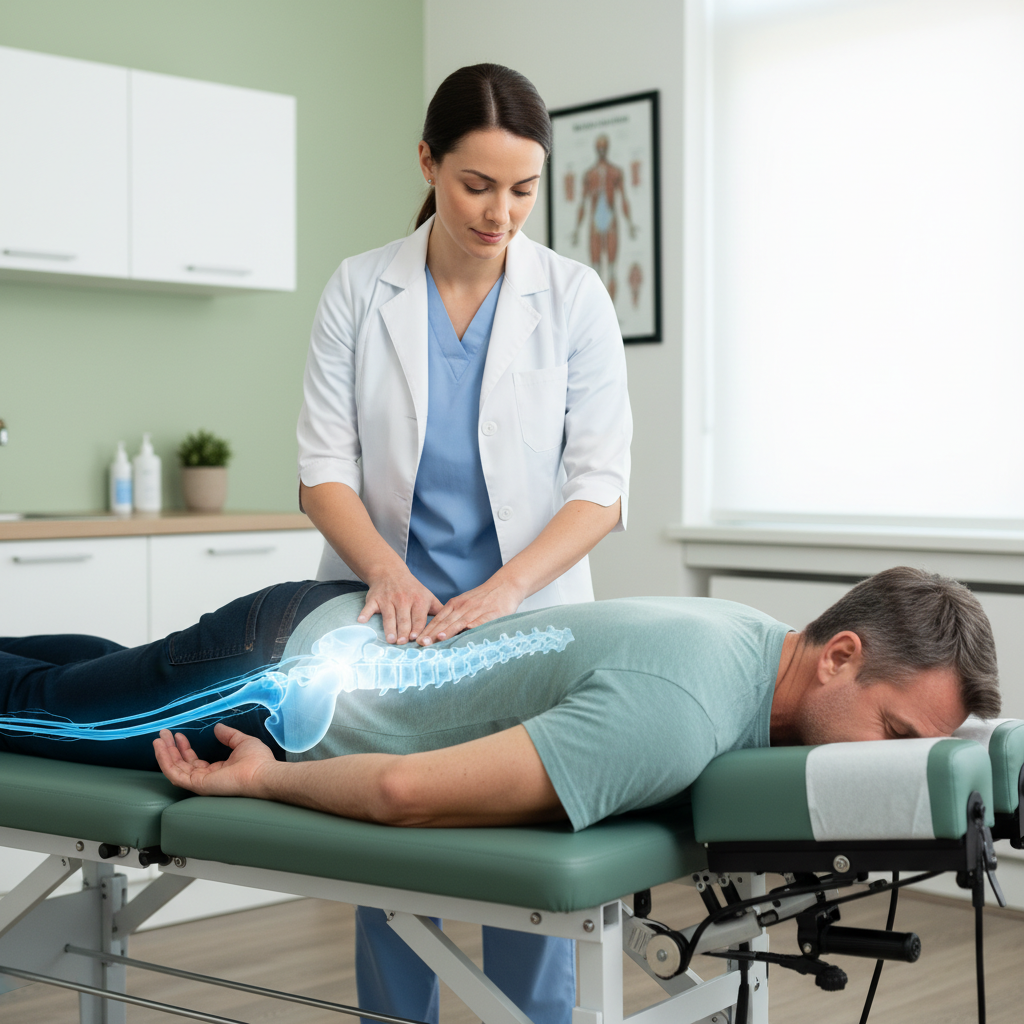
Understanding chiropractic adjustment for sciatica
If you are living with radiating leg pain, burning, numbness, or tingling, you may be dealing with sciatica. A chiropractic adjustment for sciatica is a conservative, non invasive way to relieve this nerve compression before you consider injections or surgery.
Sciatica occurs when something compresses or irritates your sciatic nerve. This large nerve runs from your lower back through your hips and down each leg. When a disc bulges, a vertebra shifts, or muscles tighten around the nerve, you can feel pain anywhere along that path. Sciatica affects an estimated 10 to 40 percent of people at some point in life, and it is most commonly triggered by a herniated disc pressing on the nerve roots in your lower spine [1].
Chiropractic care focuses on finding and correcting the source of that compression. Through targeted adjustments, mobilization, and soft tissue work, your chiropractor works to restore alignment, reduce inflammation, and give the nerve more space. This approach fits well if you want sciatica treatment without surgery and prefer to avoid heavy pain medications when possible.
How sciatica develops from nerve compression
Sciatica is a symptom pattern, not a single diagnosis. The common thread is pressure or irritation along the sciatic nerve.
Common causes of sciatic nerve compression
You might develop sciatica from:
- A lumbar herniated or bulging disc pressing on a nerve root
- Degenerative disc changes that narrow the space around nerves
- Spinal stenosis that reduces the canal space for the sciatic nerve roots
- Misalignments in the pelvis or lower back that narrow nerve openings
- Tight muscles, particularly the piriformis, that squeeze the nerve in the buttock
- Habitual postures that overload one side of your hips or spine
Habitual posture imbalance, such as always standing with more weight on one leg, can create small misalignments in your hips and lower back. Over time these shifts can compress the nerve and trigger long term sciatica pain [2].
What happens inside your body
When vertebrae or discs shift, they can narrow the openings where the nerve roots exit your spine. This reduces space for the nerve and can also inflame surrounding tissues. Muscles tighten to guard the area, which adds more pressure.
Chiropractic sciatica pain treatment focuses on realigning the spine and joints to reduce this pressure, unimpede nerve flow, balance muscle pull, and improve posture [2]. As alignment improves, nerve irritation and inflammation have a chance to resolve.
If your primary concern is nerve compression itself, you may also want to review options for sciatic nerve compression treatment to understand how different conservative therapies compare.
Sciatica symptoms you might notice
Sciatica can look different from person to person, but several patterns are common.
You may experience:
- Sharp, shooting, or burning pain that travels from your lower back or buttock down the back or side of your leg
- Numbness, tingling, or “pins and needles” in your leg or foot
- Electric shock like pain with coughing, sneezing, or sudden movement
- Muscle weakness, difficulty lifting your foot, or leg giving way
- Pain that is worse with sitting, standing for long periods, or certain positions
Some people mainly notice leg pain from sciatica, while others feel more low back pain with milder leg symptoms. It is also possible to have sciatica without much back pain at all.
Statistics suggest that 10 to 40 percent of people in the United States experience sciatica, often described as shooting or burning pain, more frequently as age increases [3].
If your leg symptoms are the most disruptive, it can be helpful to work with a radiating leg pain chiropractor who focuses specifically on nerve related leg pain patterns.
How chiropractors diagnose sciatica
Before beginning any chiropractic adjustment for sciatica, your chiropractor will evaluate whether you are a good candidate for conservative care.
Initial evaluation and history
A typical nerve pain chiropractor evaluation includes:
- A detailed discussion of your symptoms, onset, and aggravating factors
- Review of your medical history, previous injuries, and any prior imaging
- Questions about your work, daily activities, exercise habits, and posture
Chiropractic treatment sessions for sciatica often expand beyond the immediate pain. Your provider may ask about your diet, stress, and fitness level to better understand contributors to chronic neck or back issues and related neuromusculoskeletal problems [2].
Physical and neurological exam
During the exam, your chiropractor may:
- Assess your posture, gait, and spinal alignment
- Test your range of motion in the spine and hips
- Perform orthopedic tests that tension the sciatic nerve
- Check muscle strength, reflexes, and sensation in your legs
Chiropractors are trained to diagnose sciatica through this kind of comprehensive evaluation. When appropriate, they also review or order imaging, and may refer you for additional testing if needed [4].
If your presentation matches sciatic nerve compression without “red flag” signs that suggest urgent surgery, you are usually a candidate for chiropractic treatment for lumbar sciatica and other conservative measures.
What happens during a chiropractic adjustment for sciatica
Many people feel anxious about their first visit, especially if they have never had an adjustment before. Understanding what to expect can help you feel prepared and confident.
The adjustment itself
Chiropractic adjustments are gentle and controlled movements designed to improve joint alignment and motion. During sciatica care, your chiropractor focuses on the lumbar spine, pelvis, and sometimes the hips or mid back, depending on where dysfunction is found.
You can expect:
- Carefully positioned hands to apply a quick, precise force to a specific joint
- Possible “popping” or “cracking” sounds as gas is released from the joint
- Short procedures repeated on different segments as needed
Patients often hear sounds similar to knuckle popping, which indicate joint cavitation and usually coincide with a sense of relief or decreased stiffness in the treated area [2].
These adjustments aim to correct misaligned vertebrae that are putting pressure on the sciatic nerve or its roots, which can relieve pain and improve physical function [5].
Additional techniques for nerve relief
Sciatica care is rarely just one technique. Chiropractors often combine several evidence based methods, which may include:
- Spinal manipulation and mobilization to restore movement and alignment in the lumbar spine and pelvis
- Decompression therapy that gently stretches your spine to reduce pressure from herniated or bulging discs on the sciatic nerve [5]
- Trigger point therapy to release tight knots in muscles like the piriformis that can irritate the sciatic nerve [5]
- Pelvic adjustments that correct imbalances and reduce nerve compression along the nerve pathway [5]
- Flexion distraction or pelvic blocking techniques that gently traction the spine and lower back, often used when a herniated disc is present [6]
At some clinics, adjustments are combined with ultrasound, cold laser therapy, gentle manual therapy, or electrical stimulation to reduce muscle tension and inflammation and to enhance symptom relief [7].
If your sciatica is related to a known disc problem, you may wish to learn more about how a sciatica caused by disc chiropractor tailors techniques for disc related nerve compression.
How chiropractic care reduces nerve pressure and inflammation
A core goal of chiropractic therapy for nerve compression is to create better space and movement around the sciatic nerve so that irritation has a chance to calm.
Mechanical decompression and alignment
Adjustments and decompression techniques:
- Improve joint positioning so that vertebrae are better aligned
- Increase the size of openings where nerves exit the spine
- Reduce disc pressure that was bulging against nerve roots
- Balance muscle pull across the pelvis and spine
At Cox Chiropractic Clinic, for example, patients with sciatica experience reduced leg pain, tingling, and numbness as spinal alignment improves and pressure on the compressed sciatic nerve decreases with adjustments [8].
Neurological and soft tissue effects
As mechanical stress decreases, surrounding tissues can begin to normalize. Chiropractic spinal adjustments, supported by soft tissue work, help:
- Lower inflammation around the irritated nerve
- Decrease protective muscle spasms in the lower back, hips, and legs
- Restore normal joint motion that supports circulation and healing
Patients at Cox Chiropractic Clinic report better flexibility and range of motion as nerve compression is relieved and muscle tightness subsides. They often also notice restored leg strength and improved endurance for walking longer distances without fatigue, along with improved posture as spinal imbalances are corrected [8].
This broader impact is one reason many people pursue chiropractic care for nerve pain rather than relying solely on medications that only target symptoms.
What science says about chiropractic for sciatica
Research on chiropractic care for sciatica is growing, and while not every study is large, the trends are encouraging.
Chiropractic care is widely recognized as a popular natural treatment for sciatica that can relieve pain without medications and is generally considered safe as of 2024 [1]. A study cited by North East Chiropractic Center reported that 60 percent of sciatica patients who did not improve with other treatments experienced benefits from chiropractic adjustments that were comparable to surgical outcomes [5].
One 2025 study also found that people with sciatica who received chiropractic spinal manipulation instead of opioids experienced fewer side effects a year later and had a reduced need for opioid medications when chiropractic care was started early [1].
Despite some variability in study designs, many individuals report meaningful relief after chiropractic care, and it is often regarded as a low risk, holistic option that can complement or even substitute medications and physical therapy in appropriate cases [1].
If you are comparing different approaches, you may find it useful to look at chiropractic vs surgery for sciatica to understand when each is most appropriate.
How many chiropractic treatments you may need
The number of visits you will need depends on how long you have had symptoms, the underlying cause, and how your body responds to care.
Typical treatment frequency
Most patients with acute sciatica pain, meaning symptoms that started recently, require between 5 and 12 chiropractic adjustment sessions to achieve significant and lasting relief, although some continue with additional sessions to prevent future flare ups [3].
Important points to keep in mind:
- A single adjustment usually produces only small and temporary improvements, especially in more established cases
- Multiple sessions over several weeks are typically needed to create meaningful pain reduction and functional gains [3]
- After the initial phase, frequency often tapers to maintenance care once or twice per month to support mobility and prevent recurrence [3]
Many patients report feeling some relief within a few visits, but full resolution of symptoms can take several months depending on severity and how chronic the condition is [7].
If you are wondering in practical terms how long sciatica takes to heal with a chiropractor, these averages provide a useful starting point, although your plan will always be individualized.
When sciatica may improve on its own
Mild sciatica often resolves within 4 to 6 weeks without formal treatment. However, if your pain persists beyond 6 weeks, worsens, or frequently returns, seeking chiropractic care is recommended to reduce the chance of long term problems [6].
When regular office visits are not feasible, chiropractors can also guide you with targeted at home strategies. These may include stretching routines, ergonomic changes, posture work, and exercise plans designed to reduce pain and help prevent recurrence [3] and can be integrated into a broader sciatica pain relief plan.
Safety of chiropractic adjustment for sciatica
Chiropractic care for sciatica is generally considered safe when performed by a licensed and experienced chiropractor who takes time to understand your specific situation.
When chiropractic care is appropriate
Chiropractic care offers a non invasive, drug free option for treating sciatica by identifying and correcting spinal misalignments that may be compressing the nerve [4]. This approach is particularly suitable if:
- You want sciatica relief without injections or surgery
- You have radiating leg pain, tingling, or numbness without progressive severe weakness
- Your imaging shows issues like herniated discs, mild stenosis, or pelvic imbalances that are appropriate for conservative care
Chiropractic adjustments for sciatica are generally safe when tailored to your condition. A skilled chiropractor will modify or avoid techniques that could aggravate your symptoms and will refer you out if something falls outside the scope of chiropractic care [4].
When you should seek urgent medical care
You should seek immediate medical attention and inform your chiropractor if you notice:
- Sudden, severe worsening of leg weakness
- Loss of bowel or bladder control
- Numbness around your groin or inner thighs
- Trauma such as a significant fall or accident preceding symptoms
In such cases, surgery may be necessary to protect nerve function. Your chiropractor can help you determine when a referral to a spine specialist or surgeon is appropriate as part of your overall sciatic nerve pain management plan.
Chiropractic care as part of your overall recovery plan
Effective sciatica care rarely relies on a single intervention. The best results often come from combining adjustments with lifestyle and movement strategies that support healing.
At home support and lifestyle changes
Alongside in office care, your chiropractor may recommend:
- Targeted stretches and mobility drills for your hips, hamstrings, and low back
- Core and glute strengthening to stabilize your spine
- Modifications to your workstation or car seat to reduce prolonged compression
- Simple daily posture cues to reduce uneven loading on your spine and pelvis
These strategies can be especially important if you are working within a broader sciatica recovery plan chiropractor that aims not only to reduce current pain, but also to lower the risk of future episodes.
In some cases, your provider may also discuss nutrition and wellness steps that can help reduce systemic inflammation, which supports chiropractic care for nerve inflammation more broadly.
Special situations: pregnancy and chronic cases
Pregnant women often develop sciatica due to postural changes and increased load on the pelvis. Gentle chiropractic techniques, such as the Webster Technique, can help reduce back and hip pain related to pregnancy [6].
For more chronic or severe cases, some clinics integrate chiropractic adjustments with spinal decompression, dry needling, and other therapies. Dry needling, which places fine needles into muscular trigger points, can stimulate endorphin release and reduce inflammation in targeted areas [7].
This type of comprehensive care can be part of a broader strategy if you are seeking non invasive sciatica treatment options before considering more aggressive interventions.
Deciding if chiropractic adjustment for sciatica is right for you
Choosing a chiropractor for sciatica nerve pain means committing to a conservative, hands on approach that aims to correct the underlying mechanical causes of your symptoms.
As you weigh your options, consider these key points:
- Sciatica usually stems from nerve compression in your lower back or along the nerve path
- Chiropractic adjustments target that compression through realignment, decompression, and soft tissue work
- Many people notice improvement within the first few weeks, although lasting change typically requires a structured course of care
- Chiropractic care is generally safe, especially when your chiropractor screens for red flags and collaborates with your broader healthcare team
If you want a natural path to relief that respects your body’s healing capacity, chiropractic care offers a clear, non invasive option. Combining in office adjustments with personalized home strategies and, when needed, other conservative therapies can help you pursue natural sciatica pain relief with a chiropractor before you consider injections or surgery.